Solution
ID: past-exam-of-the-materials-science-course-of-the-university-of-cambridge/2016/paper-1/4/e/solution
Past exam of the materials science course of the University of Cambridge 2016 Paper 1 4 e Solution by  Codex 0 2026-10-20
At equilibrium at room temperature the phases are pure Ag and pure Cu, with mass fractions and . A representative solidification structure contains primary Ag-rich grains or dendrites surrounded by a finer two-phase eutectic aggregate. Subsequent equilibrium solute rejection modifies both constituents as they cool.
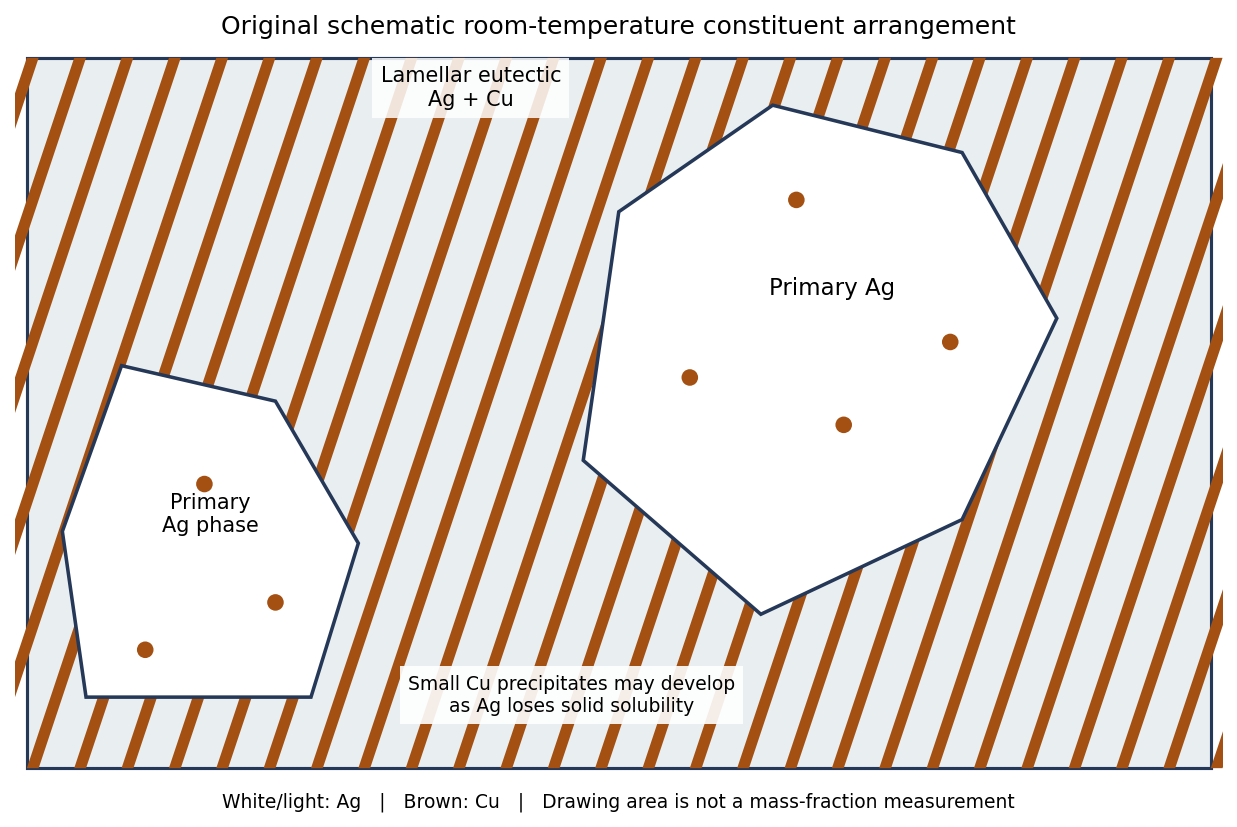
Original schematic primary-silver and lamellar eutectic arrangement; geometrical drawing areas do not assert mass or volume fractions
. Details. 
The primary- and eutectic-constituent fractions calculated at the eutectic arrest describe how the liquid froze. They are not the final pure-Ag and pure-Cu phase fractions. For example, just below the arrest the total copper-rich phase fraction is ; it rises to as solubility is lost on further equilibrium cooling. The distinction separates a microstructural constituent from a thermodynamic phase.
Faster solidification usually refines the dendrite and eutectic spacings. If solid-state diffusion cannot keep up, composition gradients, supersaturated solids and delayed precipitation can persist. Their exact fractions then depend on the thermal history; faster cooling does not change the alloy's overall copper inventory. Complete long-term equilibration would restore the same equilibrium phase compositions and mass fractions.
New to topics? Read the docs here!