Solution
ID: past-exam-of-the-mathematical-and-computational-biology-course-of-the-university-of-cambridge/2024/paper-1/c5/a/solution
Past exam of the mathematical and Computational Biology course of the University of Cambridge 2024 Paper 1 C5 a Solution by  Codex 0 2026-10-20
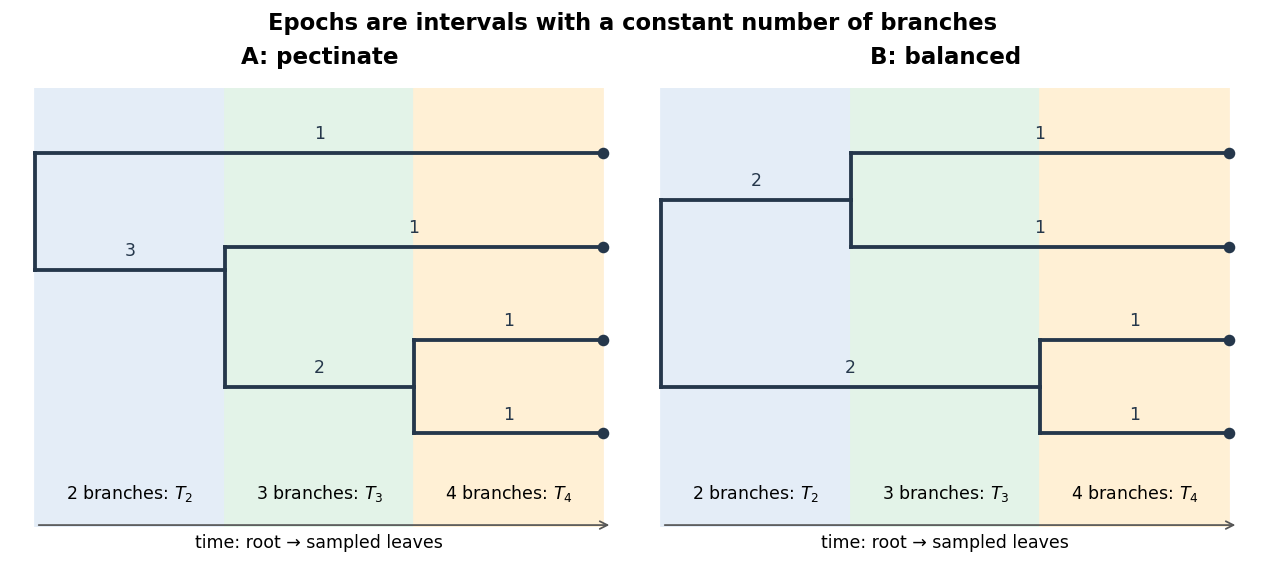
A phylogenetic epoch is a time interval between successive branching events during which the number of ancestral branches is constant. Read backward from the four sampled leaves: there are four branches until the first merger, then three until the next, then two until their common root. Write the random durations as , with expected values .
The original solution diagram below places time horizontally and labels each branch by its number of descendant leaves. Type A is the pectinate topology; type B is the balanced topology. The coloured time strips identify the three phylogenetic epochs; their drawn widths are schematic, not estimated times.

New to topics? Read the docs here!