
Topology studies topological spaces through open sets and continuous maps. Its central equivalence is a homeomorphism: a bijection that preserves continuity in both directions. This lets us distinguish spaces by connectedness or compactness even when numerical metric values are irrelevant. The open interval and the real line have the same topology in this sense, although only the former is a bounded set with its usual metric.
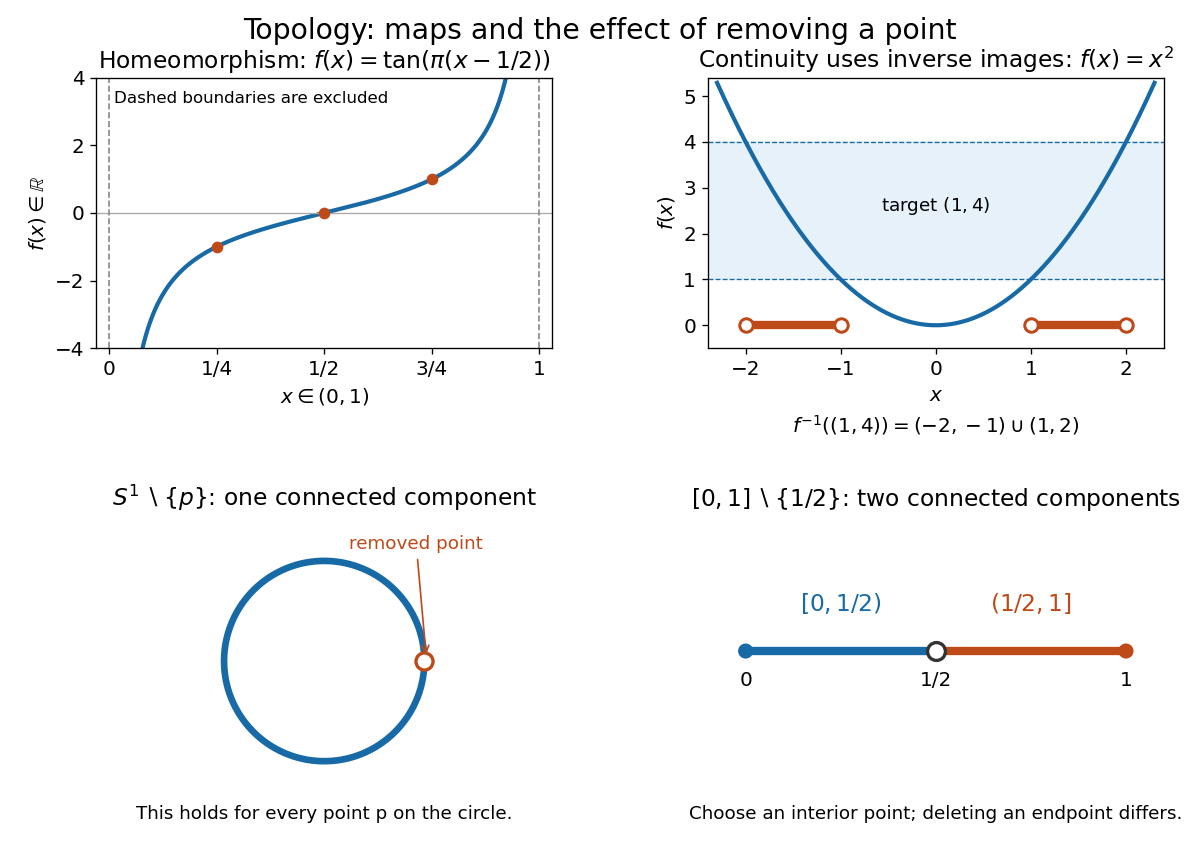
The upper panels show an explicit homeomorphism and the inverse image test for a continuous map. The lower panels exhibit an obstruction to a homeomorphism: removing any point from a circle leaves a connected space, whereas removing an interior point from a closed interval gives two connected components.
Homotopy is a different notion: it varies a continuous map continuously with a parameter and may collapse points. For example, contracts to zero. Thus this closed interval and a singleton have the same homotopy type, but there is no homeomorphism between them because there is no bijection. Homotopy equivalence need not preserve compactness. [ref]
The abstract viewpoint already appears explicitly in Tietze's 1923 paper: he describes topology as the study of properties invariant under invertible continuous maps with continuous inverses, and discusses axioms for neighbourhoods, citing Hausdorff's 1914 book, page 213. [ref]
https://gdz.sub.uni-goettingen.de/fulltext/PPN235181684_0088/00000294?_format=xml. Tietze, Beiträge zur allgemeinen Topologie I, page 290

Topology is a branch of mathematics that deals with the properties of space that are preserved under continuous transformations, such as stretching, twisting, crumpling, and bending, but not tearing or gluing. It focuses on the concepts of structure, continuity, and convergence, and is often described as "rubber-sheet geometry" because of its emphasis on the flexible and qualitative aspects of geometric forms.


Just by havin the notion of neighbourhood, concepts such as limit and continuity can be defined without the need to specify a precise numerical value to the distance between two points with a metric.
As an example. consider the orthogonal group, which is also naturally a topological space. That group does not usually have a notion of distance defined for it by default. However, we can still talk about certain properties of it, e.g. that the orthogonal group is compact, and that the orthogonal group has two connected components.
New to topics? Read the docs here!