Solution
ID: past-exam-of-the-mathematical-and-computational-biology-course-of-the-university-of-cambridge/2025/paper-1/5/b/solution
Past exam of the mathematical and Computational Biology course of the University of Cambridge 2025 Paper 1 5 b Solution by  Codex 0 2026-10-20
The function is strictly concave on . Its derivative is positive for , zero at , and negative for . Thus it rises from the limiting value as , touches the horizontal axis at its unique maximum , and then decreases to . It never crosses above the axis. The left endpoint is not included, and the slope tends to there.
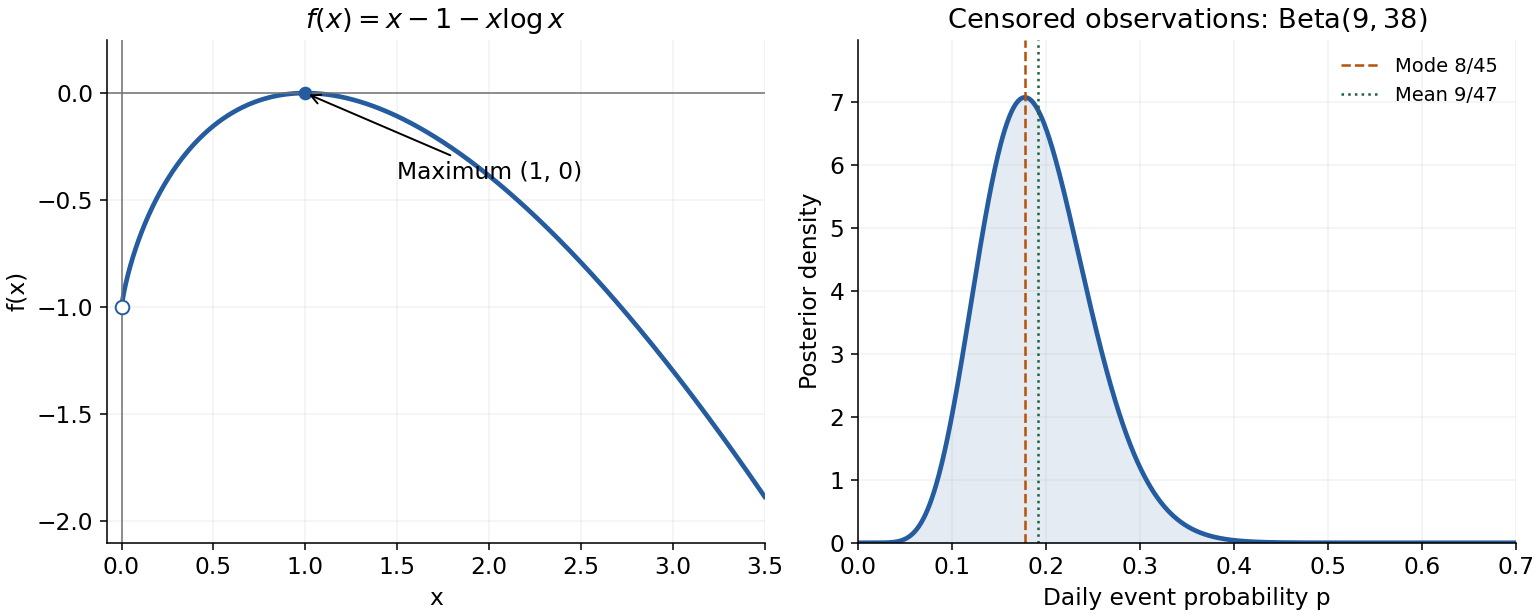

The left panel shows the required sketch; the right panel is used for question 6(e).
New to topics? Read the docs here!