Solution
ID: past-exam-of-the-mathematical-methods-i-course-of-the-university-of-oxford/2015-resit/10/solution
Past exam of the mathematical methods I course of the University of Oxford 2015 resit 10 Solution by  Codex 0 2026-10-25
Dividing Newton's equation by the mass gives the stated model: is the acceleration, represents viscous damping, is the spring's restoring acceleration, and the right side is the applied driving force per unit mass. The complex notation is a convenience; the physical displacement is the real part. Put . The homogeneous characteristic roots areFor and damping , oscillations occur when , the underdamped case of the damped harmonic oscillator.
For a steady response , substitution givesTaking the modulus and phase givesThe phase is between zero and for positive damping and frequency; an unqualified arctangent loses the correct quadrant above resonance.
With the real drive and real response , the average driving power equals the dissipated viscous power:For , write this asIt is largest when the squared term vanishes, givingThis power peak is at even when the displacement-amplitude peak is shifted. The frequency bandwidth of viscous oscillator power absorption follows from the half-power condition :In fact the bandwidth identity is exact in this model. Sharp resonance additionally gives . With zero damping at exact resonance, there is no bounded steady harmonic response to which these finite-power formulas apply.
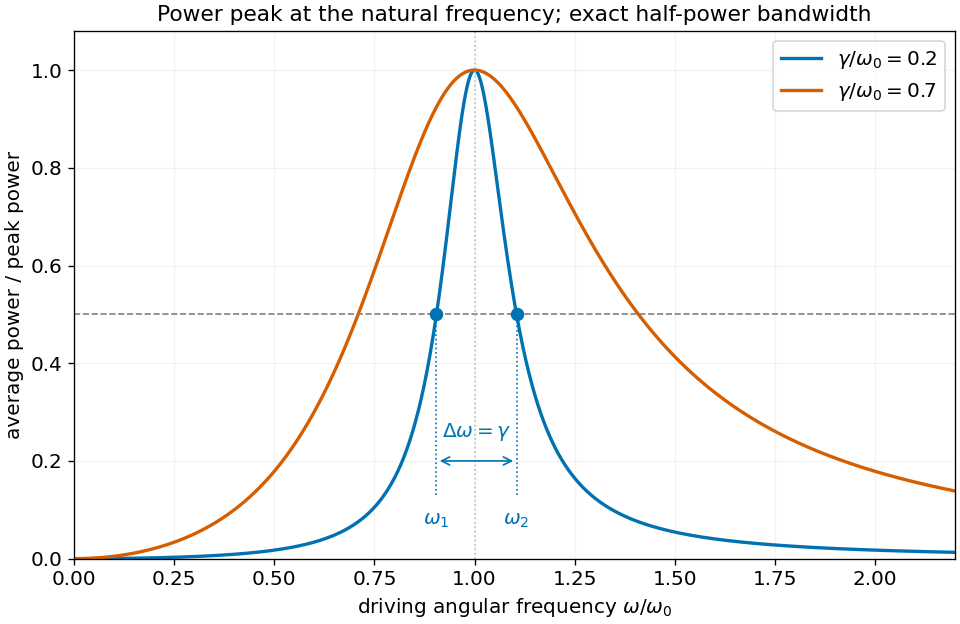
Driven-oscillator power peaks at the natural frequency; the exact separation of the half-power frequencies is the damping coefficient
. Details. 
New to topics? Read the docs here!