Solution
ID: past-exam-of-the-mathematical-physiology-course-of-the-university-of-oxford/2011/1/c/i/solution
Past exam of the mathematical physiology course of the University of Oxford 2011 1 c i Solution by  Codex 0 2026-10-31
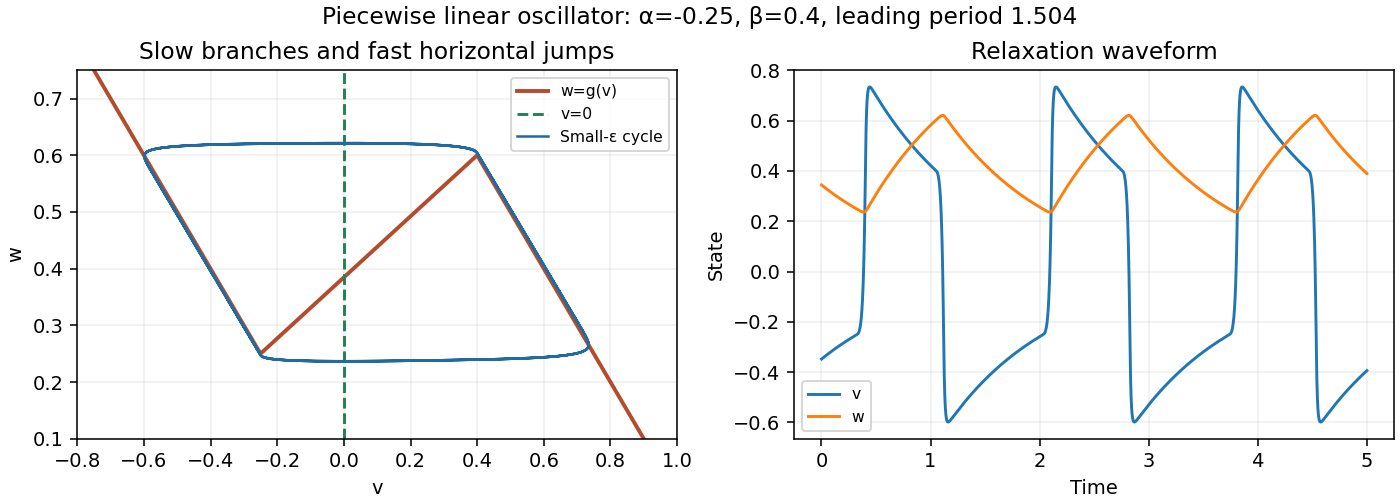
The nullclines are and . The two outer pieces of have slope ; the middle piece has positive slopeThe curve is continuous, with folds and . The unique equilibrium is . Its Jacobian matrix has trace and determinant , so it is unstable. The outer branches attract the fast voltage motion.
The jumps are almost horizontal in the phase plane, because changes negligibly on the fast time. Below , voltage increases; above it, voltage decreases; increases on the right of and decreases on the left. These signs provide a closed trapping region around the indicated route for sufficiently small positive , with the unstable equilibrium excluded, giving a periodic orbit by the planar return-map or Poincaré-Bendixson theorem argument. The continuous piecewise linear field is locally Lipschitz, so solution uniqueness is available at the corners.

New to topics? Read the docs here!