Solution
ID: past-exam-of-the-mathematics-and-the-environment-and-mathematical-physiology-course-of-the-university-of-oxford/2010/b/5/c/i/solution
Past exam of the mathematics and the environment and mathematical physiology course of the University of Oxford 2010 B 5 c i Solution by  Codex 0 2026-10-31
For the chain rule gives , , . ThusAs increases from the material ahead of the wave towards that behind it, the singular pulse construction is . The front raises at approximately fixed from the low root to the high root. On the plateau , on the right attracting branch while rises slowly. The back decreases at approximately fixed to the left attracting branch. The recovery tail then lowers back to zero on that branch, returning to . Both sharp transitions have thickness in ; the other segments have the slower recovery scale.
The figure labels all four points and the front/back orientations. This frozen-recovery construction needs as well as if is large, so that the recovery variable remains nearly fixed in an inner transition. It also needs an admissible positive front speed for the chosen orientation, addressed below.
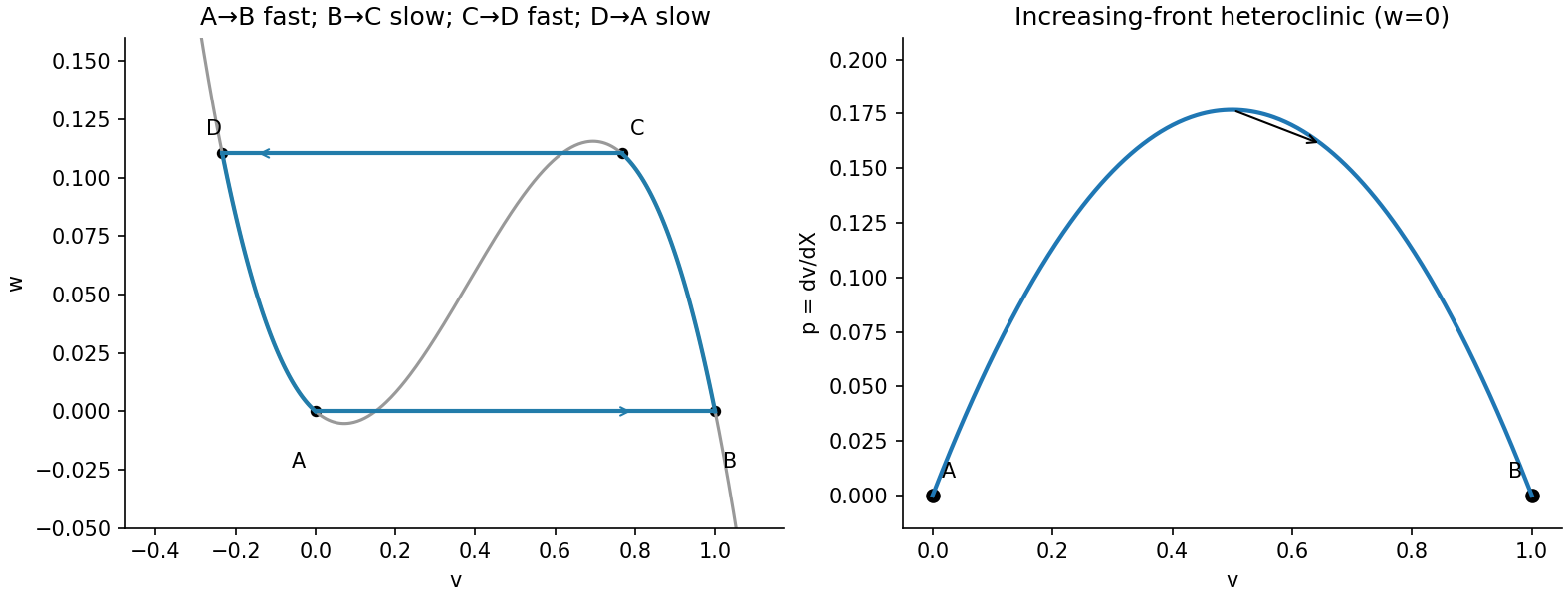
Matched front, plateau, back and recovery tail, with the inner front heteroclinic orbit
. Details. 
New to topics? Read the docs here!