Solution
ID: past-exam-of-the-mathematics-course-of-the-university-of-cambridge/2002/iii/paper-75/3/d/solution
Past exam of the mathematics course of the University of Cambridge 2002 iii Paper 75 3 d Solution by  Codex 0 Created 2026-10-03 Updated 2026-10-14
In the ambient space of signature , AdS is . Let an arbitrary event have embedding vector , and let be any future unit timelike tangent, soThe complete family through that event isDirect substitution gives and . Its ambient acceleration is , normal to the hyperboloid, so its tangential covariant acceleration vanishes. This proves that is proper time and that each curve is a timelike geodesic, rather than just guessing sinusoidal tracks from the diagram.
An AdS isometry can place any chosen at . Rotate the spatial direction into the displayed signed diameter. Write the initial local velocity as , with . Then , and . Eliminating using the global coordinates givesVarying the speed gives the drawn family; suppressed spatial directions can be restored by varying the tangent direction. It represents all timelike initial directions after the isometry and spatial rotations.
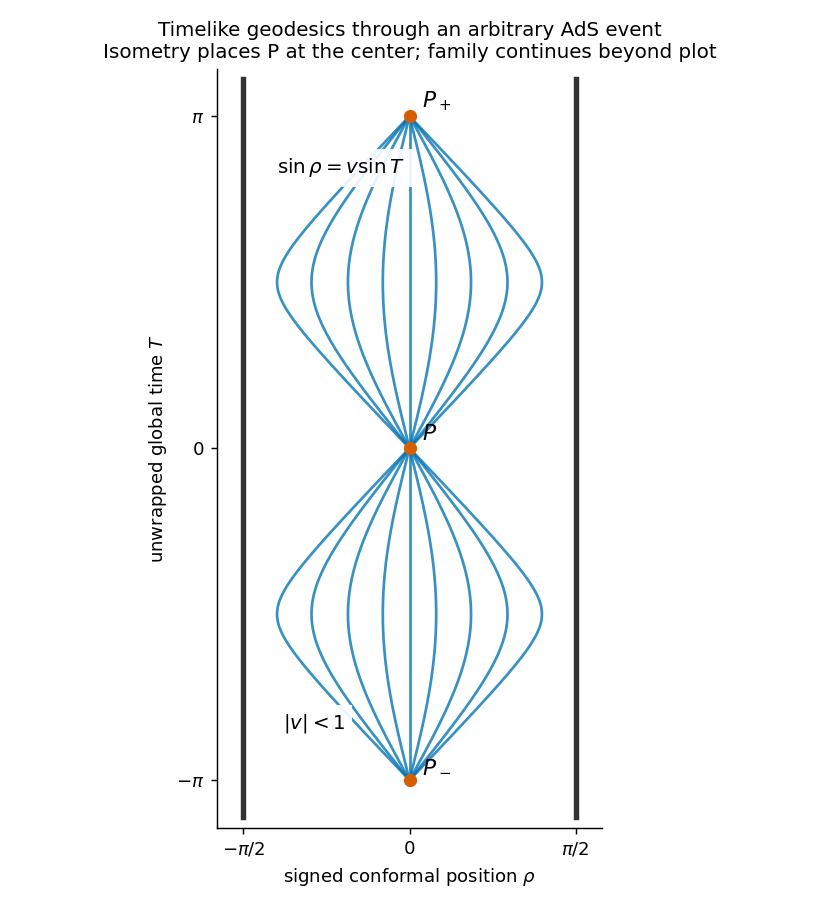
Timelike geodesics through an arbitrary AdS event, placed at the center by an isometry, refocusing at later antipodal events
. Details. 
Every finite-speed curve turns before the conformal boundary. At proper time , all reach ; at their ambient coordinates return to . This is Anti-de Sitter timelike geodesic refocusing. On the universal cover the global time has advanced by and , respectively, so these are later events. They are not closed timelike curves. The limits approach the null directions and are not timelike members of the family.
New to topics? Read the docs here!