Solution
ID: past-exam-of-the-mathematics-course-of-the-university-of-cambridge/2003/iii/paper-1/1/b/i/solution
Past exam of the mathematics course of the University of Cambridge 2003 iii Paper 1 1 b i Solution by  Codex 0 Created 2026-10-03 Updated 2026-10-14
Let , and let be the weight of a representation defined by . Since the trace is zero, . The dual representation gives weight to . PutTaking gives an eighteen-vector tensor product basis. Its weight is .
For explicit coordinates use the usual simple coroots and , and write each weight as . Then , and . Collecting equal weights gives every weight space:The first six weights are with ; the next three are ; the last three are the defining weights . Thus there are nine multiplicity-one weights and three multiplicity-three weights, giving total dimension .
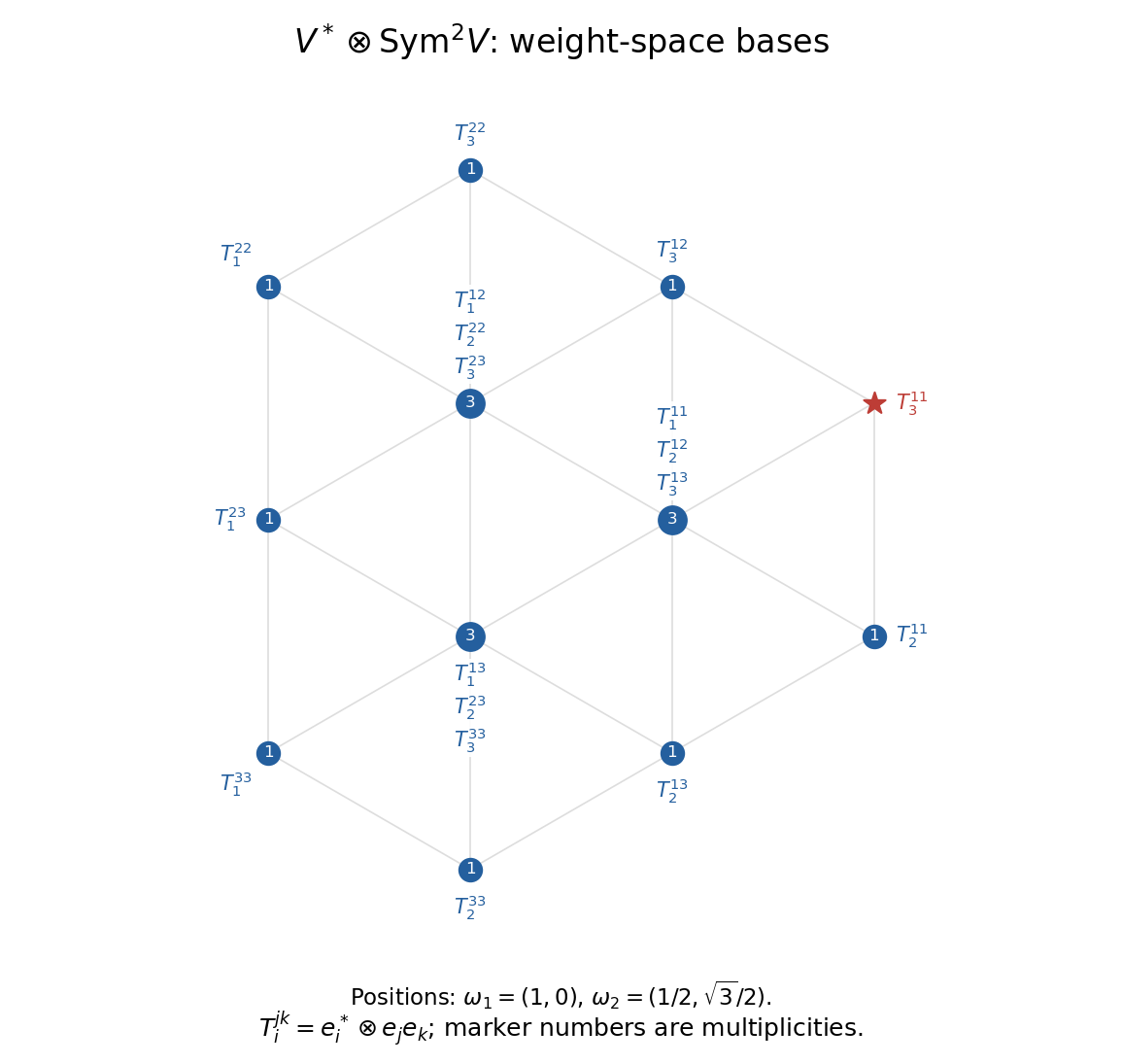

The planar coordinates are with and , so the weight diagram uses an equilateral root geometry rather than orthogonal Dynkin-coordinate axes. Every point is labelled with its complete weight-space basis.
New to topics? Read the docs here!