Solution
ID: past-exam-of-the-mathematics-course-of-the-university-of-cambridge/2003/iii/paper-12/4/ii/solution
Past exam of the mathematics course of the University of Cambridge 2003 iii Paper 12 4 ii Solution by  Codex 0 Created 2026-10-03 Updated 2026-10-14
The lower bound cannot hold at as printed: a simple graph on three vertices has at most three edges, so . We prove the intended bound for every , and hence its stated asymptotic order.
Delete leaves from a connected graph of graph excess one to obtain its nonempty 2-core. Deleting a leaf and its incident edge preserves edges minus vertices. The deleted part is a forest rooted at the core vertices: it cannot contain a cycle, which would survive deletion, and it cannot join two core vertices, since the joining path would itself survive. The 2-core remains connected. Suppress its maximal paths with degree-two internal vertices, allowing coincident endpoints for a cycle based at a branching vertex. The resulting graph kernel is a connected multigraph of minimum degree at least three, retaining loops and parallel edges, with the same excess one.
In that kernel,Thus it has either one degree-four vertex or two degree-three vertices. In the first case its two edges are loops. In the second, let be the number of edges between the two vertices and the loop counts. Connectivity gives , and , leaving or . This proves the bicyclic kernel classification: the two-loop bouquet graph, the three-edge Theta graph, and the two-loop dumbbell graph. Original simple cores are graph subdivisions of these kernels; loops must subdivide to cycles of length at least three, and at most one of the three theta paths can be an unsubdivided edge.
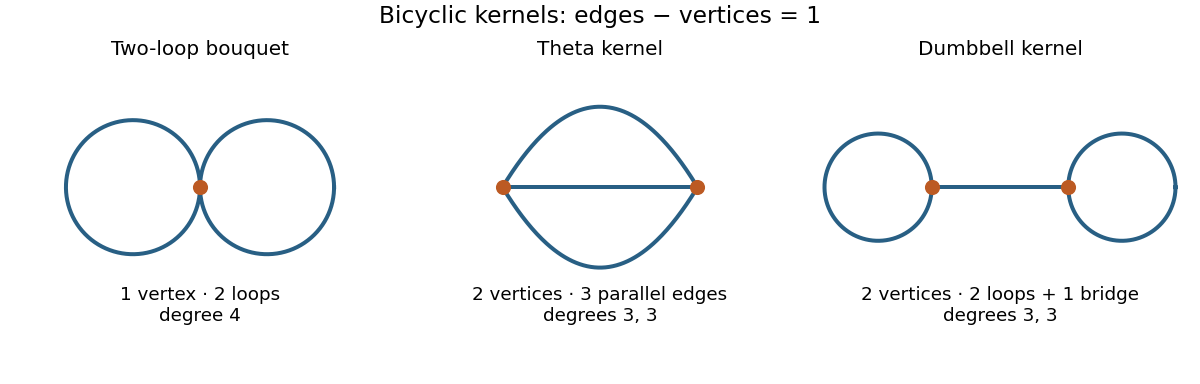
The two-loop bouquet, theta and dumbbell kernels of connected bicyclic graphs
. Details. 
Let count labelled bicyclic cores on a fixed -vertex set. The classification gives an absolute constant withTo see the bound concretely, order the one or two branching labels, choose one of the three kernel types, and distribute the other labels as ordered internal vertices of its two or three edges. There are at most weak compositions of their lengths, and at most ordered assignments of all labels. This overcounts orientations and edge permutations and ignores simplicity restrictions, both harmless for an upper bound.
For a lower bound, use only theta cores whose three paths each have at least one internal vertex. For , choose an ordered pair of branching vertices and an ordered list of the other labels, then cut that list into three nonempty ordered paths. There are encodings. Every resulting simple theta core is encoded exactly times, by swapping the branching vertices and permuting the three paths. Hence
Choose the core's vertices and attach the forest counted in part (i). The decomposition is unique, soPutting , the two estimates on reduce the labelled bicyclic graph count to the sum of divided by .
For the upper bound, givesThe corresponding sum is . For example, divide the positive integers into blocks : the sum in block is at most a constant times , and the series over converges. Including the finitely small indices makes no difference. Therefore .
For the lower bound, take sufficiently large and . Then , and throughout the product. Since on ,There are at least such integer indices, each with . The lower core bound therefore givesThis proves the two-sided bounds for all sufficiently large . They extend to every by adjusting the constants over the remaining finite set: there, since minus one edge is connected with five edges, and adding a pendant path supplies an example at every larger order. Consequently the correctly qualified conclusion isThe exceptional is a genuine defect in the printed quantifier, not a missing case of the proof.
New to topics? Read the docs here!