Solution
ID: past-exam-of-the-mathematics-course-of-the-university-of-cambridge/2003/iii/paper-59/1/e/solution
Past exam of the mathematics course of the University of Cambridge 2003 iii Paper 59 1 e Solution by  Codex 0 Created 2026-10-03 Updated 2026-10-14
For the supplied normal form, the four local topological phase portraits are as follows. When , only the origin is present and it is a saddle equilibrium. When , the origin is attracting, between the two outer saddle equilibria; inward-facing separatrices enter its basin. When and , the origin is repelling and a stable limit cycle surrounds it, inside the separatrix boundary formed by the outer saddle equilibria. Finally, when , the origin remains repelling but the local limit cycle has disappeared, and trajectories leave the central region through the opened separatrix channels. Whether the origin is a node or a focus within one of these regions does not change this orbit topology.
On the connection curve, the two outer saddle equilibria are joined in both directions; the period of the disappearing limit cycle diverges. This is a heteroclinic cycle, not a pair of saddle homoclinic orbits. The sketches below show the four open regions of the supplied system; they are not presented as phase portraits of the inequivalent printed spherical equations.
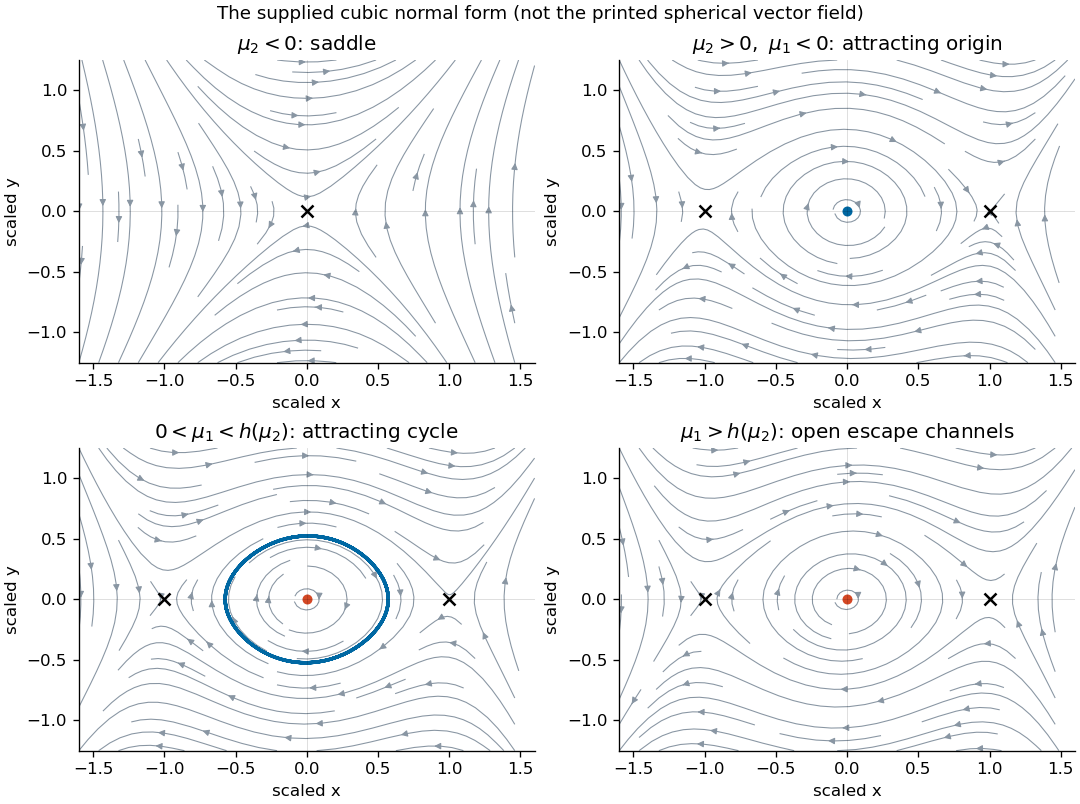
Four phase portraits of the supplied reflection-symmetric cubic normal form
. Details. 
New to topics? Read the docs here!