Solution
ID: past-exam-of-the-mathematics-course-of-the-university-of-cambridge/2004/iii/paper-42/3/solution
Past exam of the mathematics course of the University of Cambridge 2004 iii Paper 42 3 Solution by  Codex 0 Created 2026-10-03 Updated 2026-10-14
Let the summands have mean mu, variance , and cumulants . For the standardized sum , expansion of its log-characteristic function gives a normal leading term and successively smaller cumulant terms. Fourier inversion turns these terms into Probabilists' Hermite polynomials. Under sufficient moments and a smooth nonlattice condition, the Edgeworth expansion beginsfor bounded z. Higher orders include the fourth cumulant and products of lower cumulants. This is a central expansion in powers of ; it need not remain positive, normalized, or accurate in far tails after truncation.
For a saddlepoint density approximation, require the summand cumulant-generating function K to be finite on an interval about zero. At a sum value , find the interior saddle satisfying . Exponential tilting makes the tilted mean y, so the tilted sum is approximated locally by its normal probability density at its mean. Undoing the tilt givesEquivalently this follows by deforming the transform-inversion contour through its stationary point. Suitable analytic and nonlattice regularity gives relative error at fixed interior y. This approximation incorporates a nonquadratic tail exponent and is positive, while an Edgeworth truncation uses a normal probability density times a polynomial. It uses more information from the distribution and stronger exponential-moment assumptions. Its integral may differ from one by a higher-order amount, so positivity does not imply exact normalization.
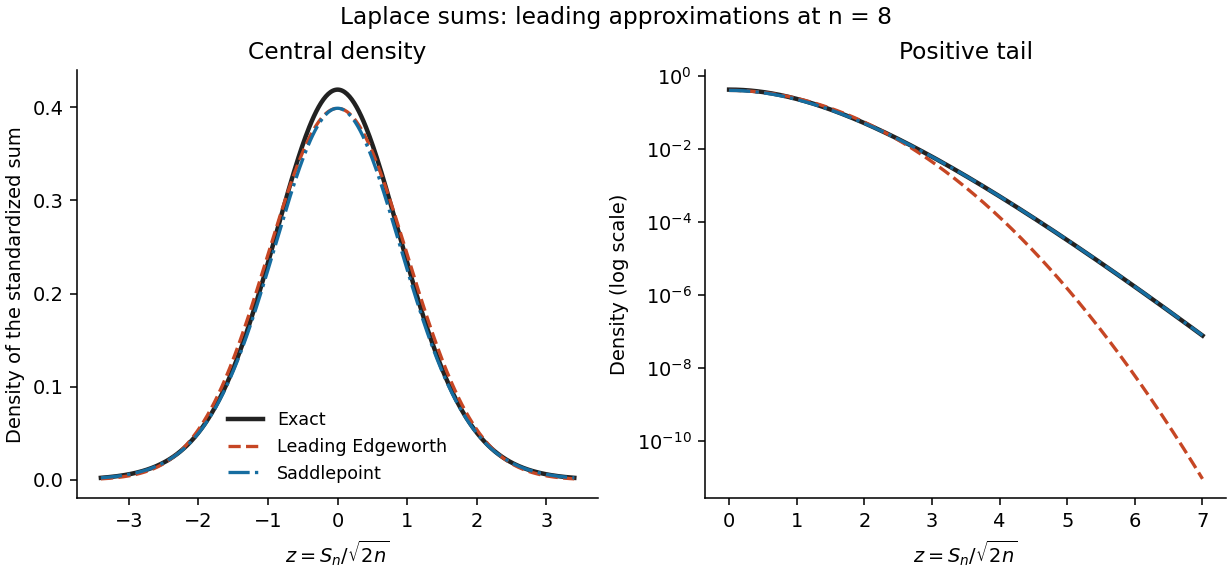
For the centered Laplace distribution, , hence and . Its skewness vanishes, so the order- Edgeworth correction is zero. With , the requested expansion, omitting terms of order in the standardized correction, isFor bounded z the exact probability density function is this expression times . The prefactor is because this is the probability density function of the unstandardized sum; that change of units should not be confused with the orders inside the Edgeworth expansion.
For the saddlepoint, . Write and . The root in isThese formulas include without a division by y. Substitution yieldsThis is the leading saddlepoint approximation, without its order- relative correction. Expanding d near one recovers the same central normal approximation, while retaining d captures the Laplace-sum large-deviation exponent away from the center.

New to topics? Read the docs here!