Solution
ID: past-exam-of-the-mathematics-course-of-the-university-of-cambridge/2004/iii/paper-46/1/e/solution
Past exam of the mathematics course of the University of Cambridge 2004 iii Paper 46 1 e Solution by  Codex 0 Created 2026-10-03 Updated 2026-10-14
A tricritical point occurs when a first-order boundary meets a continuous-transition boundary. In the spin-inversion-symmetric sextic Landau free energy, two independent parameters must tune , while keeps the potential stable. In the plane, the continuous boundary is , and the first-order boundary is . They meet at the tricritical point; the order-parameter jump on the first-order side tends to zero as . The first panel shows this phase diagram, including the metastability limits derived above.
Along the tuned line , the equation of state is . Thus on a selected ordered branch, rather than the ordinary square-root behavior. Differentiation gives inverse magnetic susceptibility above and below, while at criticality . Hence the mean-field tricritical exponent calculation yields , , ; the minimized potential also gives . These tricritical powers require tuning the quartic coefficient, not merely varying a generic temperature path. The ordinary scalar exponents requested separately are calculated next.
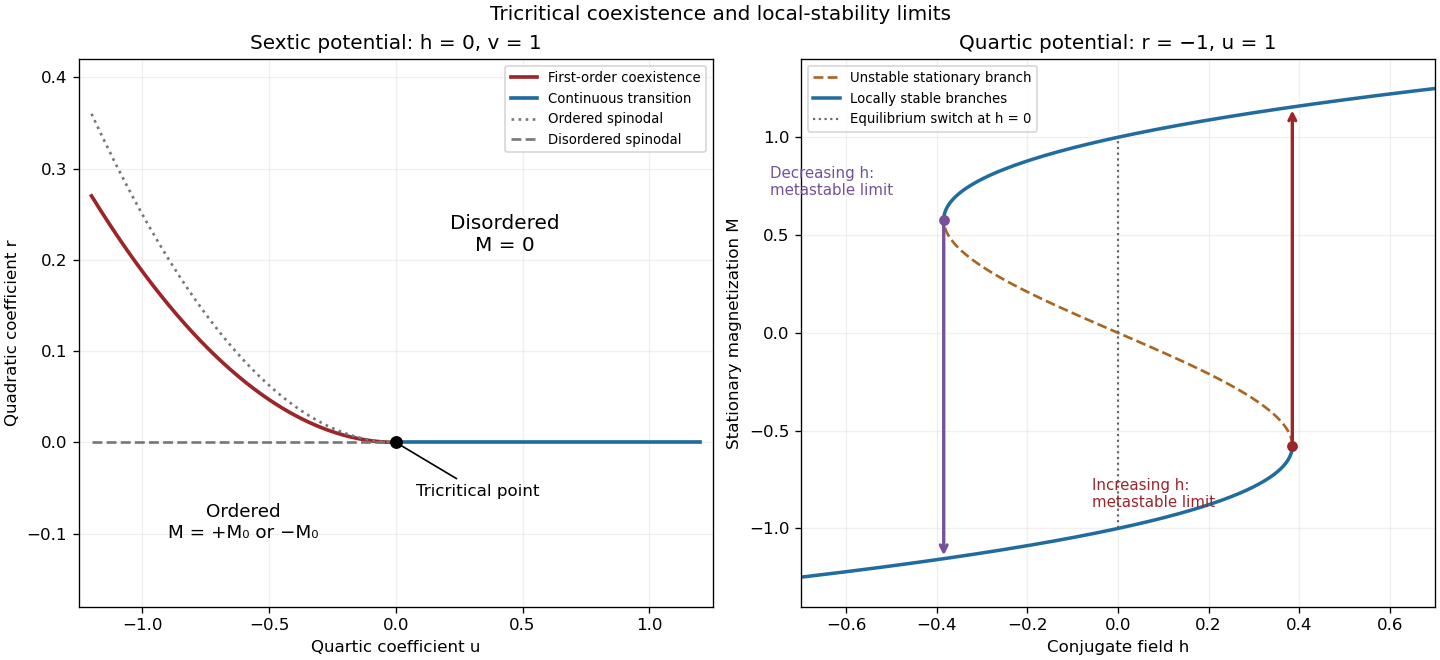
Scalar sextic Landau phase diagram with a tricritical point, and quartic metastable hysteresis branches
. Details. 
New to topics? Read the docs here!