Solution
ID: past-exam-of-the-mathematics-course-of-the-university-of-cambridge/2004/iii/paper-60/4/c/solution
Past exam of the mathematics course of the University of Cambridge 2004 iii Paper 60 4 c Solution by  Codex 0 Created 2026-10-03 Updated 2026-10-14
For a fixed point write . A saddle-node bifurcation requires both and . For these conditions giveThe second derivative is nonzero at either nonzero saddle-node bifurcation, making it an ordinary saddle-node bifurcation. For , defineThe saddle-node bifurcations occur at and , and three scalar fixed points coexist for . The two outer branches have fixed-point multiplier below one and are stable, while the middle branch is unstable. Negative points lift to two symmetry-related limit cycles, so these scalar branch counts need not equal the number of flow limit cycles. The cusp records coexistence of distinct return-map branches; even outside it a negative branch represents a symmetry-related pair of flow cycles.
If , , thenThis exponentially narrow region ends in a gluing-map cusp at . At its boundaries the graph of is tangent to the diagonal at or , as shown below. At exactly , and gives one stable fixed point for nonzero .
For , the formal saddle-node bifurcation radius is , and the corresponding saddle-node bifurcation parameters also diverge. Thus the near-origin gluing-map cusp lies on the side; the formal large saddle-node bifurcations of the power-law formula on the other side are outside the local gluing-map approximation. They must not be drawn as a second small gluing-map cusp near the origin.
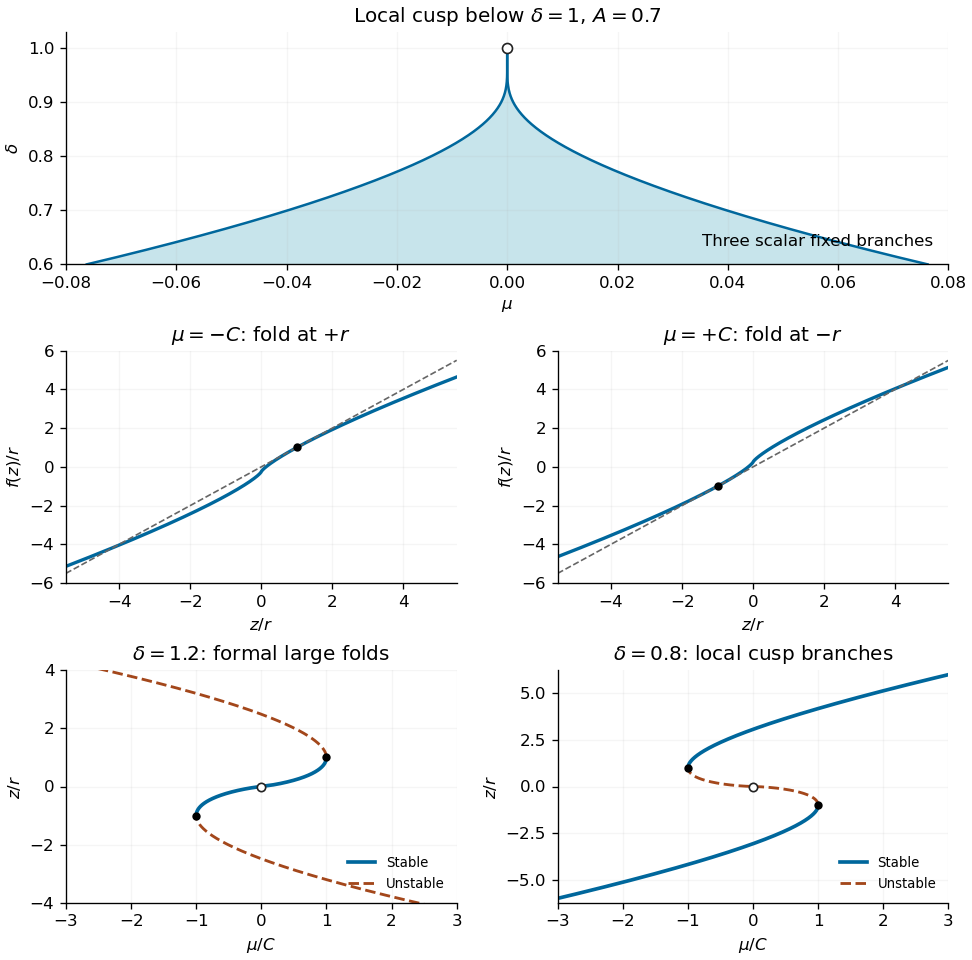
Exponentially narrow gluing-map cusp, tangencies at its two fold boundaries, and stable and unstable fixed-point diagrams on either side of delta one
. Details. 
New to topics? Read the docs here!