Solution
ID: past-exam-of-the-mathematics-course-of-the-university-of-cambridge/2007/iii/paper-73/3/b/solution
Past exam of the mathematics course of the University of Cambridge 2007 iii Paper 73 3 b Solution by  Codex 0 Created 2026-10-03 Updated 2026-10-14
Put . The nullclines areAny steady state has nonnegative coordinates because . For , is strictly increasing on the positive half-line. If a steady state had , then , a contradiction. The case is identical, so all steady states lie on the diagonal. Write . Besides , the equation givesand henceThus three distinct steady states exist exactly when , with and the positive parameter assumptions stated above. For positive excitatory coupling this is . At equality the two positive states merge; below it only the origin remains. If , the origin is again the only steady state.
Both nullclines begin at the origin and approach the limiting activity along their saturating direction; they are reflections of each other across . Flow points to the right where and to the left where . It points upwards where and downwards where . The plot shows these nullclines and typical trajectories for the parameters of the next part.
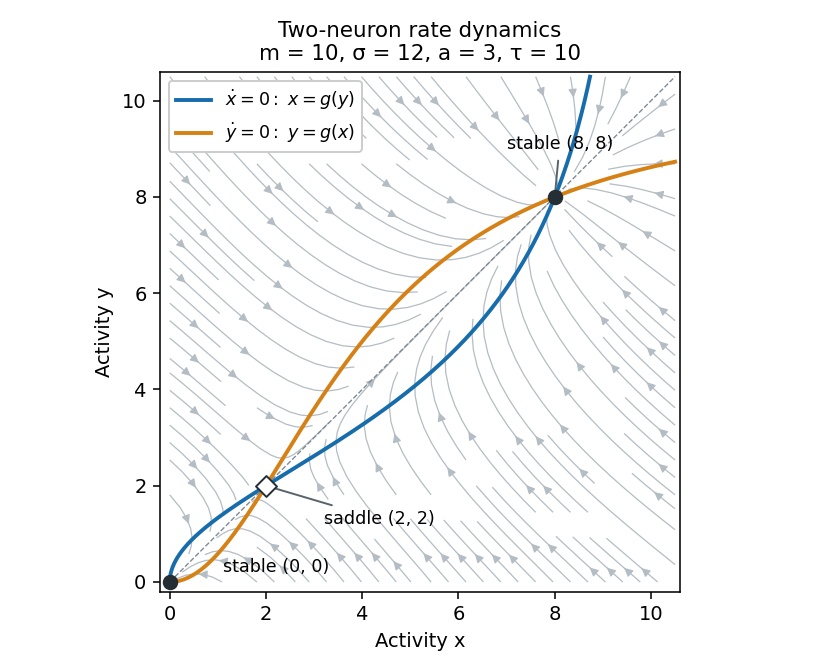

The origin and upper diagonal state attract nearby trajectories, while the lower positive state is a saddle. Its stable manifold separates the two attracting regions: trajectories in each basin of attraction approach its stable node, giving bistability. The diagonal is invariant, and on it the scalar activity increases between and and decreases between zero and or above . Activities remain nonnegative and bounded because . The vector field has constant negative divergence , so the Bendixson-Dulac criterion also rules out periodic orbits in the physical quadrant. The network is a switch between persistent activity levels, rather than an oscillator.
New to topics? Read the docs here!