Solution
ID: past-exam-of-the-mathematics-course-of-the-university-of-cambridge/2007/iii/paper-74/3/b/solution
Past exam of the mathematics course of the University of Cambridge 2007 iii Paper 74 3 b Solution by  Codex 0 Created 2026-10-03 Updated 2026-10-14
Use the approximate reaction-rate equations from part (a), with axes and . In every case the positive quadrant is forward invariant, since the drift on either zero-concentration axis points inward. The nullclines specify the arrow signs: right if , left if the inequality is reversed; up if , down otherwise.
For and , the nullclines are the vertical line and the horizontal line . The two components relax independently:Every nonstationary trajectory is a straight ray towards the unique stable equilibrium , whose Jacobian matrix is .
For and , both derivatives equal , so the two nullclines coincide onEvery point of this hyperbola is an equilibrium. The difference is conserved, and trajectories therefore run along straight lines of slope one. Below the hyperbola they point up and right; above it they point down and left. Each such line converges to its own intersection with the hyperbola,At this point the Jacobian matrix is , with eigenvalues and . Thus the equilibrium curve attracts transversely but has no restoring drift along its tangent. Its points are not individually asymptotically stable, because arbitrarily close initial states on different constant-difference lines converge to different equilibria.
For and , the nullclines are the decreasing curves and , reflected in the diagonal. At an intersection, subtracting the two stationary equations gives . Hence there is exactly one intersection, whereThe Jacobian matrix at this point isIts symmetric eigenvector has eigenvalue , and the antisymmetric eigenvector has eigenvalue . Both are negative, so the symmetric equilibrium is a stable node. All trajectories are bounded because each component above decreases. The divergence excludes periodic orbits by the Bendixson-Dulac criterion, and the unique interior equilibrium attracts the positive-quadrant trajectories. As becomes small, the drift restoring the difference becomes slow, so paths first approach the near-hyperbolic nullclines and then drift towards the symmetric intersection. These sketches show the three cases printed in the PDF; the middle case is , not the different cases introduced by the converted TeX.
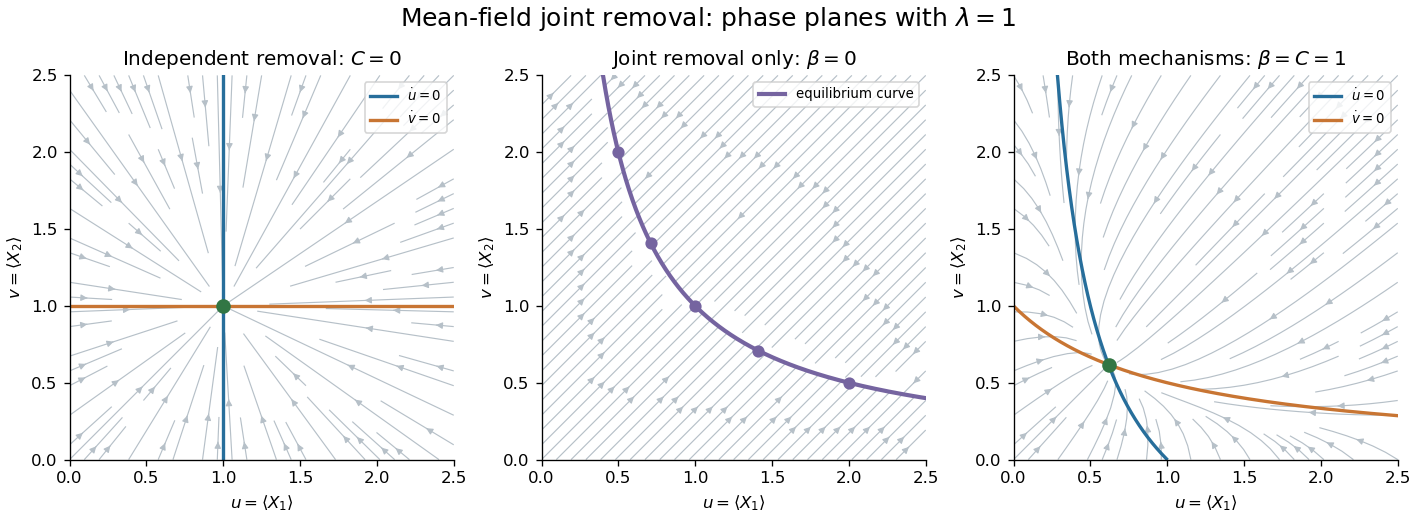
Mean-field phase planes with independent removal, exclusive joint removal, and both removal mechanisms
. Details. 
New to topics? Read the docs here!