Solution
ID: past-exam-of-the-mathematics-course-of-the-university-of-cambridge/2008/iii/paper-78/1/b/solution
Past exam of the mathematics course of the University of Cambridge 2008 iii Paper 78 1 b Solution by  Codex 0 Created 2026-10-03 Updated 2026-10-14
With the stated time rescaling, and , where primes refer to . Dividing by givesAt , put and define the HamiltonianIts orbital derivative is , so this is a conserved quantity. The Hamiltonian system has , .
For , set . The potential has a minimum at and a maximum at . The corresponding center equilibrium and saddle equilibrium have energies and . Levels contain closed ovals around , as well as separate unbounded components on the right. At , the center's ovals limit to a homoclinic orbit to the saddle, turning at . Its equation isThe same energy also has external unbounded saddle separatrices for . Levels above pass over the potential barrier and are open. Along the upper halves , so the closed loops are traversed clockwise. If , the two critical points coalesce into a degenerate equilibrium; if , the potential is strictly decreasing and there is no center or homoclinic loop.
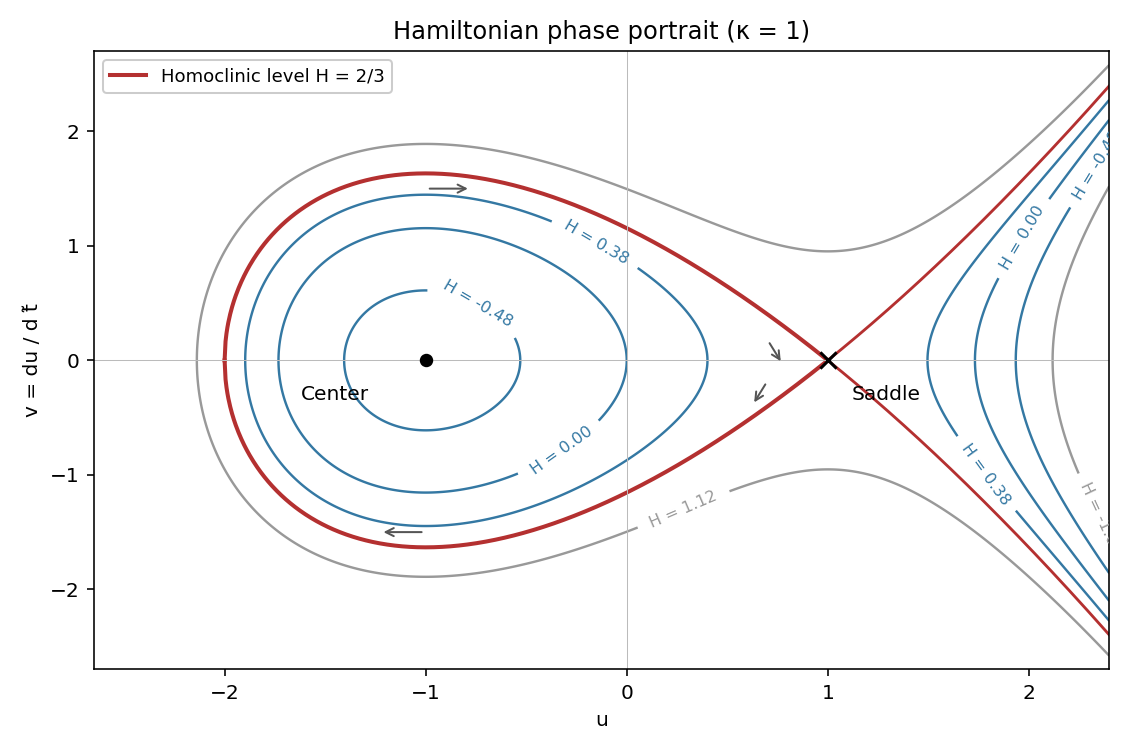
Hamiltonian level curves for kappa equal to one, showing the center, saddle and homoclinic loop
. Details. 
New to topics? Read the docs here!