Solution
ID: past-exam-of-the-mathematics-course-of-the-university-of-cambridge/2009/ib/paper-1/13d/solution
Past exam of the mathematics course of the University of Cambridge 2009 ib Paper 1 13D Solution by  Codex 0 Created 2026-09-24 Updated 2026-10-14
Choose the principal branch of a multivalued function, , for . The integrand has simple poles at and a branch cut along the negative real axis. Its residues arewhose sum is .
For , close the Bromwich contour to the left using a rectangle with outer real part and horizontal edges at imaginary parts , indenting the cut and zero. On every distant edge, , and . Each edge has length and , so its integral is . The small circle of radius about zero contributes . The tails of the original vertical integral are absolutely bounded by as well.
On the upper and lower banks at , the square roots are and , respectively. With the upper bank traversed toward zero and the lower bank away from zero, their combined integral isThe cut integral converges near zero since is integrable, and at infinity by exponential decay. The residue theorem, followed by and , therefore givesFor , close the Bromwich contour to the right. There are no enclosed poles or cuts, and there. The same distant-edge estimates show for .
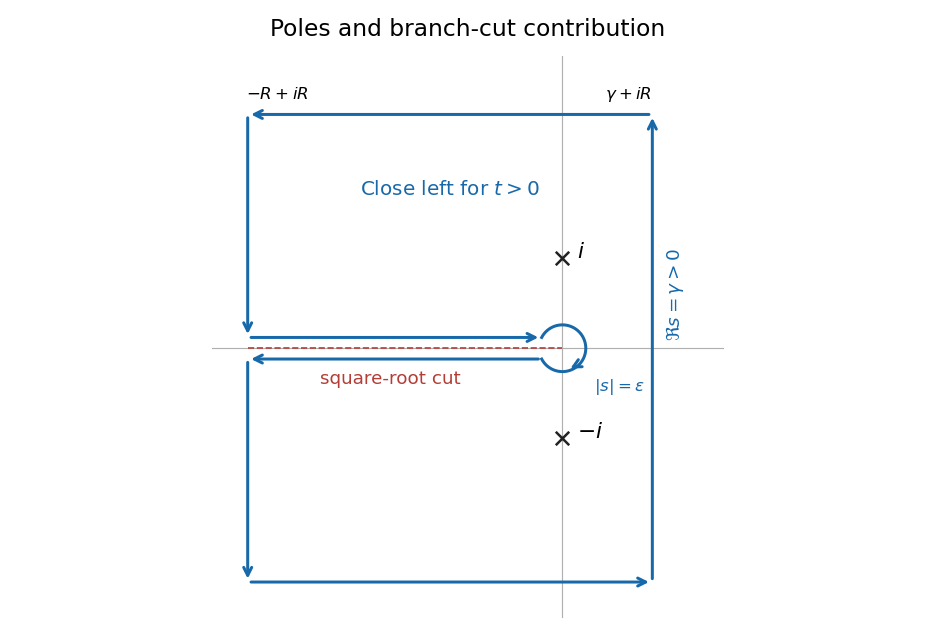
Left-closing Bromwich contour with the principal square-root cut, two pole residues, and a small indentation at zero
. Details. 
For the large- expansion, . Scaling and using the given integral yields . Integration by parts twice gives the next coefficient . The remainder is bounded by . Thus, without needing a globally convergent termwise integration of the local power series,In particular, the requested two leading terms are , interpreted as an additive asymptotic expansion. This is Bromwich inversion with a square-root branch cut.
New to topics? Read the docs here!