
Integration by parts transfers a derivative from one factor of a product to the other, while keeping an endpoint contribution. Its usefulness comes from choosing which factor becomes simpler when differentiated, and which has an accessible antiderivative. The integral is then replaced by a boundary term minus another integral.
For real continuously differentiable functions on , the precise definite integral formula isIn the shorter notation, and , giving for indefinite integrals, with a constant of integration understood. The product rule says ; the fundamental theorem of calculus turns its integral into the endpoint difference. Thus the formula packages a differentiation rule into a tool for integration.[ref]
For example, choose and . Then and , since the exponential function is its own derivative:The boundary term is ; the remaining integral is . Their difference is exactly one. The endpoint product alone would overcount, because its derivative includes as well as the desired .
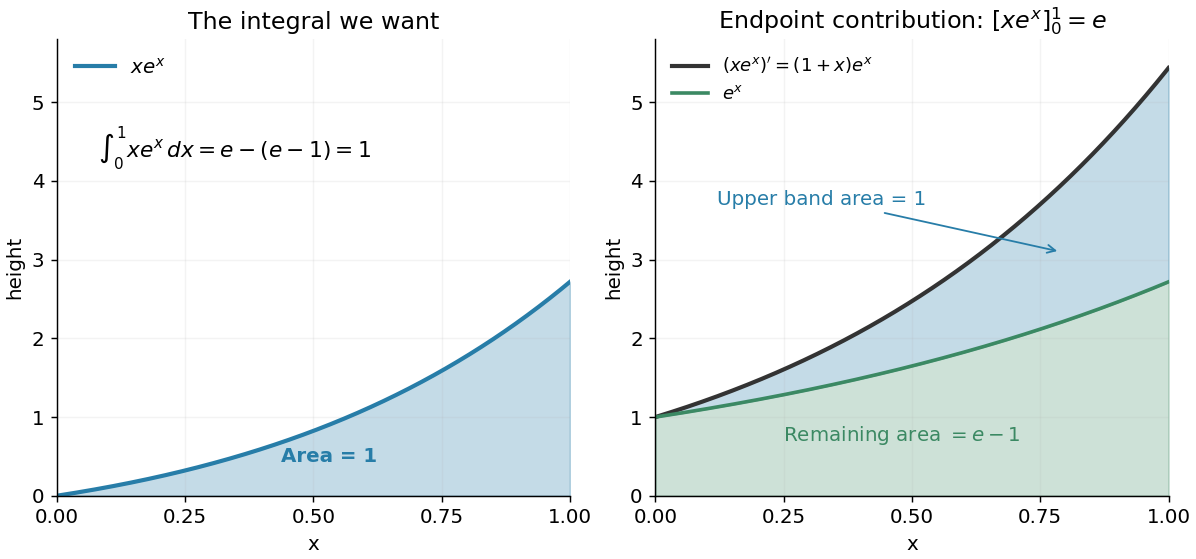
Integration by parts splits the accumulated product derivative into the desired integral and the remaining integral
. Details. In the figure, the area under is the endpoint contribution . Its lower band has area , and its upper band has thickness and area one. This decomposition makes the subtraction visible. The endpoint contribution is a difference of product values; it need not equal the area under either factor separately.
The same choice repeatedly lowers the degree of a polynomial when integrating a polynomial times an exponential function, while choosing gives for . More broadly, moving a derivative onto a convenient test function is the mechanism behind a weak derivative. Always evaluate the boundary term: it disappears only when the relevant endpoint values justify doing so, often through a boundary condition.


Integration by parts is a technique used in calculus to integrate the product of two functions. It's based on the product rule for differentiation and is particularly useful when dealing with integrals of the form \( \int u \, dv \), where \( u \) and \( dv \) are functions that we can choose strategically to simplify the integration process.
New to topics? Read the docs here!