Solution
ID: past-exam-of-the-mathematics-course-of-the-university-of-cambridge/2010/iii/paper-36/4/e/solution
Past exam of the mathematics course of the University of Cambridge 2010 iii Paper 36 4 e Solution by  Codex 0 Created 2026-10-03 Updated 2026-10-14
Model 2 is an errors-in-variables model: the follow-up regression depends on a latent true baseline rather than substituting its noisy observation. A common normal distribution for the true baselines provides partial pooling and allows uncertainty about each baseline to propagate to the regression coefficients and predictions. Conditional on the shared parameters, the child-specific factorization isThe Directed acyclic graph below includes the shared parameters, the two local latent variables, both observed measurements, and the deterministic regression mean. The outer plate repeats over children and the inner plate over follow-up visits. Filled nodes are observed; rectangular mean nodes are deterministic.
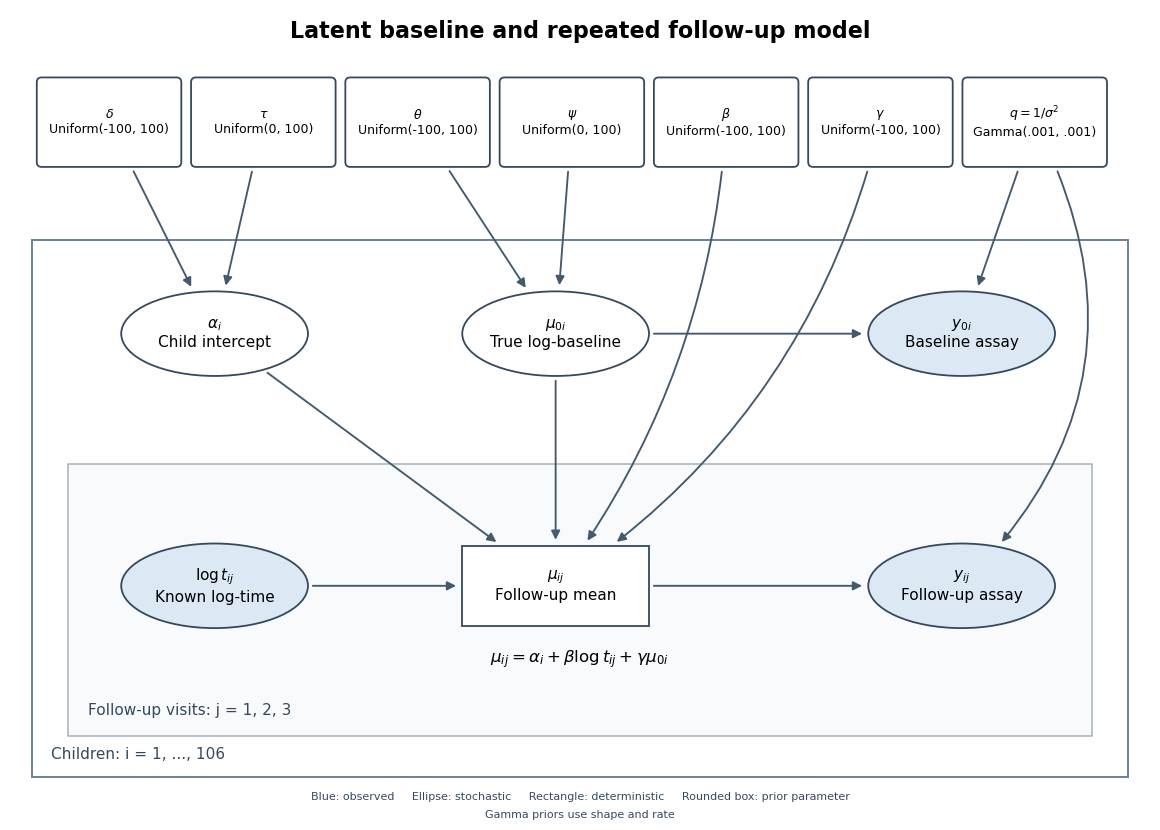
Directed graph of the latent-baseline random-intercept model, including shared priors, baseline measurement error and repeated follow-up visits
. Details. 
One complete adapted BUGS specification uses the non-centered form of the random intercept, retaining the original priors and adding proper broad priors for and :
for (i in 1:N) {
  z[i] ~ dnorm(0, 1)
  alpha[i] <- delta + tau*z[i]
  truebase[i] ~ dnorm(theta, baseprec)
  baseline[i] ~ dnorm(truebase[i], noiseprec)
  for (j in 1:3) {
    followmean[i,j] <- alpha[i] + beta*log(time[i,j]) + gamma*truebase[i]
    followup[i,j] ~ dnorm(followmean[i,j], noiseprec)
  }
}
noiseprec ~ dgamma(0.001, 0.001)
beta ~ dunif(-100, 100)
gamma ~ dunif(-100, 100)
delta ~ dunif(-100, 100)
tau ~ dunif(0, 100)
theta ~ dunif(-100, 100)
psi ~ dunif(0, 100)
baseprec <- 1/(psi*psi)
Here is the number of children,
baseline and followup contain the observed data, and dnorm uses precision rather than variance. The priors on the newly introduced population baseline mean and standard deviation are explicit choices, not consequences of the likelihood; sensible alternatives can be checked for sensitivity. The code uses the noisy baseline only in its own measurement likelihood, and uses truebase in every follow-up mean. New to topics? Read the docs here!