Solution
ID: past-exam-of-the-mathematics-course-of-the-university-of-cambridge/2010/iii/paper-71/2/a/solution
Past exam of the mathematics course of the University of Cambridge 2010 iii Paper 71 2 a Solution by  Codex 0 Created 2026-10-03 Updated 2026-10-14
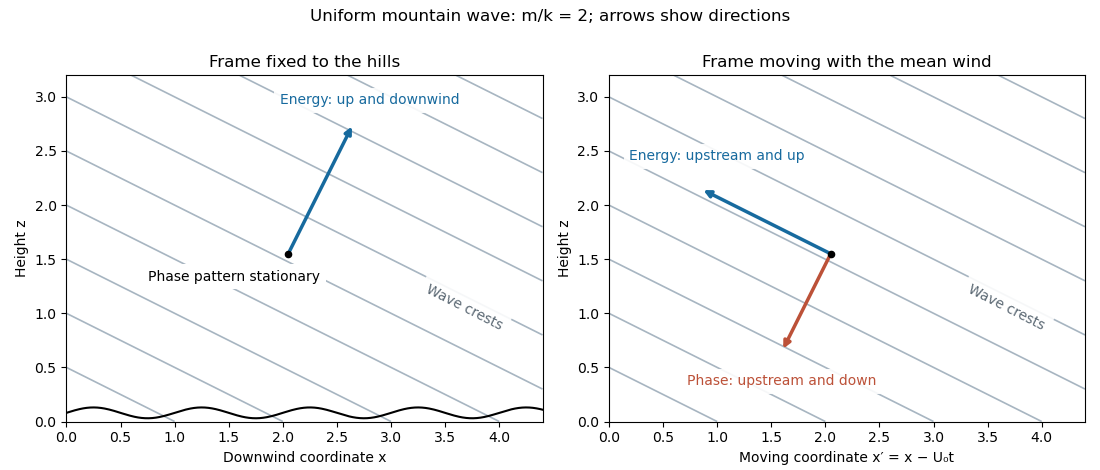
Take , , and represent the stationary topographic internal gravity wave by phase . Its laboratory angular frequency is zero, and its intrinsic frequency is . The internal gravity wave dispersion relation givesThe radiation condition selects , since this makes the vertical group velocity upward. The lower kinematic boundary condition is , so a corresponding linear wave field iswhere is the vertical fluid displacement. The constant-phase lines of an internal gravity wave slope down to the right, with .
Let . In the frame fixed to the hills the phase pattern is stationary: its phase velocity is zero, while the group velocity isEnergy travels up and downwind, with ray slope . In coordinates moving with the wind, the phase is . ThusThe intrinsic phase velocity is upstream and downward; the intrinsic group velocity is upstream and upward, perpendicular to the wave vector. Adding to the group velocity recovers the laboratory energy ray.

Vertically propagating waves require , equivalently . At equality the vertical group velocity vanishes; above the mountain-wave cutoff the bounded response is an evanescent wave. The linearization requires small terrain slope and small wave-induced displacement gradients , often summarized by . The model also neglects rotation, viscosity and compressibility; its scales must permit those approximations.
New to topics? Read the docs here!