Solution
ID: past-exam-of-the-mathematics-course-of-the-university-of-cambridge/2012/iii/paper-45/2/b/solution
Past exam of the mathematics course of the University of Cambridge 2012 iii Paper 45 2 b Solution by  Codex 0 Created 2026-10-03 Updated 2026-10-14
Eliminating the auxiliary field gives and the nonnegative F-term scalar potentialUse after the critical-point shift, so thatThis notation keeps the original parameters distinct from the shifted mass coefficient . For real with , the real slice is . It has zero-energy minima at and , a maximum between them at with height , and grows quartically toward both ends. These statements follow by differentiating: .
When it becomes , with one degenerate zero minimum. When , it is after a permissible shift. For the real parameters with negative discriminant, the original real slice can have a positive minimum even though the full complex scalar potential has zero-energy vacua away from that slice. The sketch distinguishes these regimes:
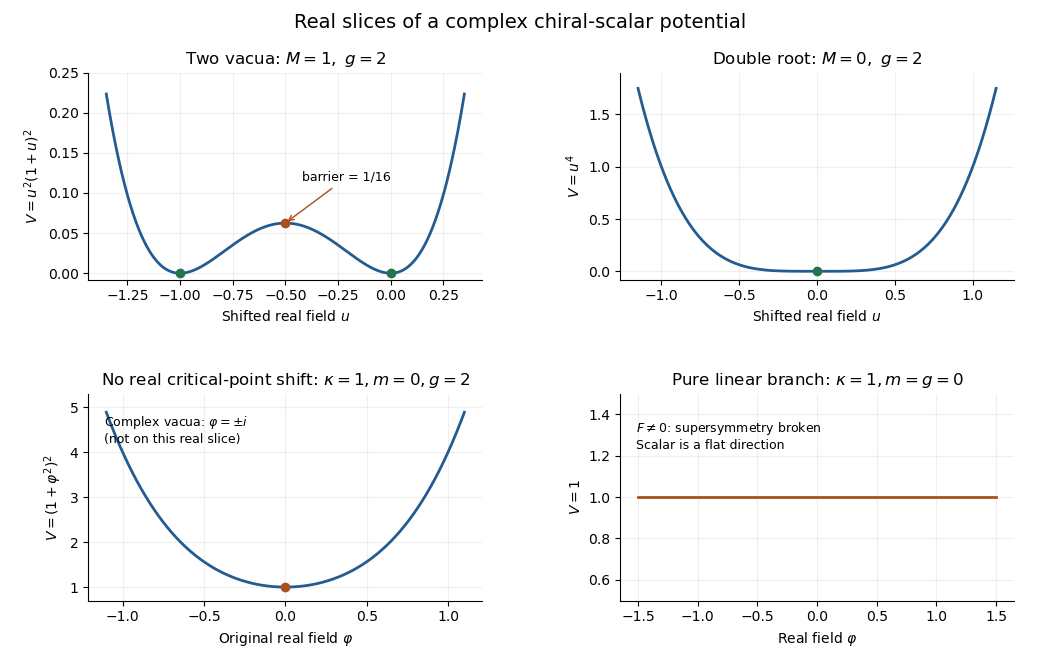
Real scalar-potential slices: two supersymmetric minima, a double root, complex vacua off the slice, and flat F-term breaking
. Details. 
The plots use illustrative normalized coefficients, not values fixed by the exam. A positive minimum on a chosen real slice is not evidence for supersymmetry breaking in the full complex field space.
New to topics? Read the docs here!