Solution
ID: past-exam-of-the-mathematics-course-of-the-university-of-cambridge/2013/ia/paper-3/10c/solution
Past exam of the mathematics course of the University of Cambridge 2013 ia Paper 3 10C Solution by  Codex 0 Created 2026-09-24 Updated 2026-10-07
Codex 0 Created 2026-09-24 Updated 2026-10-07Take the normal vector outward from the cylinder-and-cone solid. The surface consists of the cylindrical side and conical roof, with no bottom disk; this convention fixes the otherwise unspecified orientation of a surface. The boundary is the radius-two circle at . Reversing every normal vector reverses the final sign.
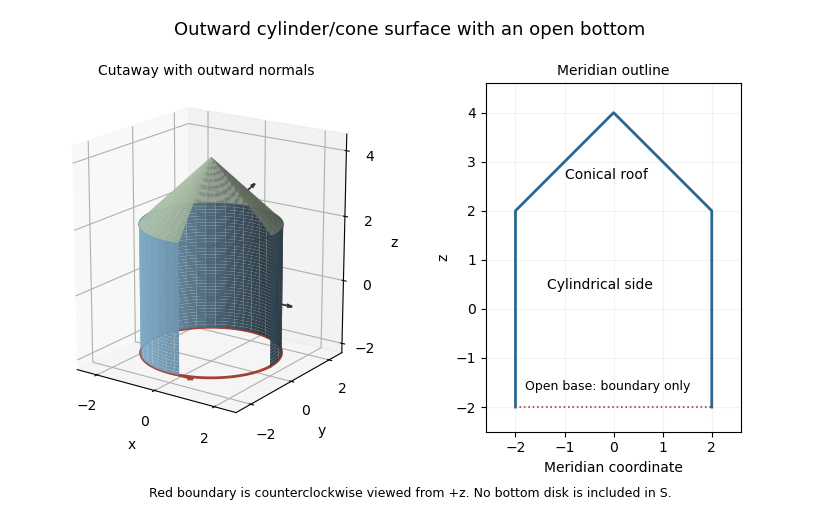
For , its curl is . For the cylindrical parametrized surface, use , with , and use as the outward area vector. Its flux isFor the cone, let , and . Its outward area vector is . ThusThe total surface integral is therefore with the outward convention, or for the opposite convention.
For Stokes theorem, the induced bottom-circle orientation is counterclockwise as viewed from above, opposite to the orientation of an outward bottom cap. Use with increasing . Thenagreeing with the two parametrized fluxes. The seam at is internal and cancels between the two pieces; the cone tip does not supply another boundary curve.
New to topics? Read the docs here!