A normal vector at a point of an embedded smooth manifold is orthogonal to every tangent vector in its tangent space, using the surrounding dot product. Its direction describes departure from the local tangent geometry. For a regular level set with nonzero gradient, is a normal vector: differentiation of along any curve on the level set gives .
For a plane curve, the normal direction is a straight line perpendicular to its unit tangent vector; the two unit normals differ by sign. For a curve in three-dimensional Euclidean space, the orthogonal directions form a two-dimensional plane. A principal normal vector selects one of them using curvature, so it must be distinguished from an arbitrary normal vector.
At a point of a smooth surface with nonzero normal vector , its normal line is . For a level set with , one can use .
On with , the gradient of the defining function gives a normal proportional to . Its Euclidean norm is , proving the displayed normalization. This upward normal lies on the boundary of the Lorentz cone, so self-duality of a second-order cone makes its pairing with every point of the closed upper cone nonnegative.
A unit normal is a normal vector of Euclidean norm one. Given a nonzero normal vector , normalization gives . This makes a dot product measure the signed length of the normal component, without an extra factor from the length of . On a hypersurface, the two opposite choices and correspond to opposite normal orientations; a continuous choice on an orientable surface fixes its orientation of a surface.
Along the boundary of an oriented surface, the outward unit conormal lies in the tangent plane of the surface and is perpendicular to the boundary unit tangent vector. If is the chosen unit normal vector, the positively oriented unit tangent vector is .
At a point on a plane curve, or on a hypersurface with unit normal , a vector splits into a normal component and a tangential component:The terms are orthogonal projections, and . Changing to reverses the scalar coefficient , but leaves the normal component vector unchanged.
For a plane curve, a unit tangent vector and a unit normal form an orthonormal basis, givingAt on the parabola , choose and . For ,Their sum is and their inner product is zero. A negative normal coefficient means that the normal component points opposite the chosen , rather than giving it a negative Euclidean norm.
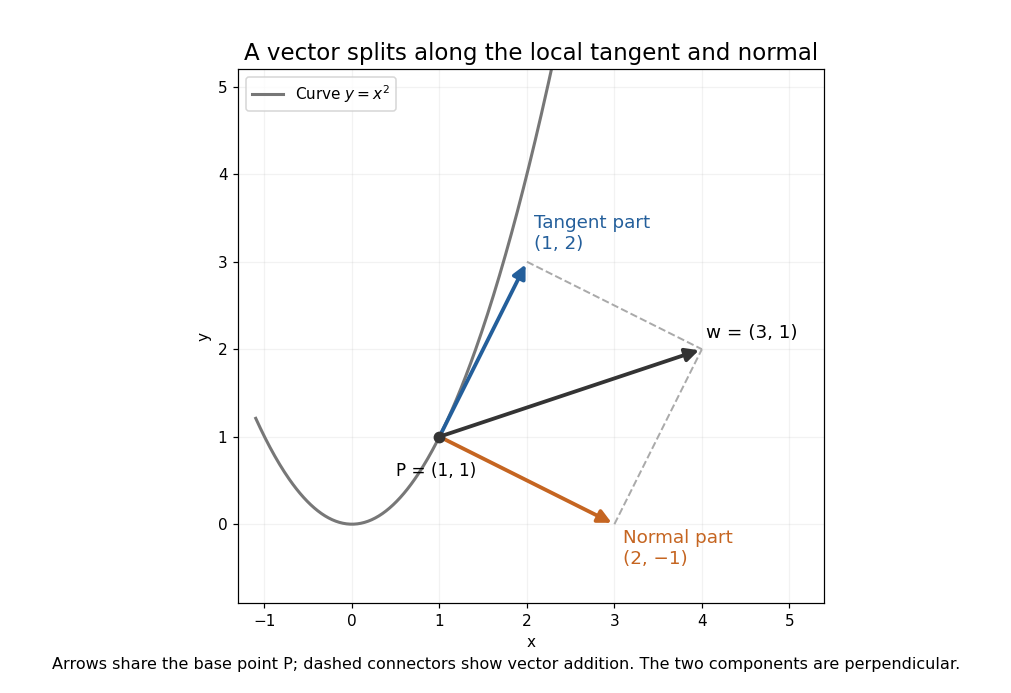

These are local directions: being tangent at a point does not mean that a straight displacement stays on the curve. For a space curve, the normal part can have both principal normal vector and binormal vector components; projecting onto one chosen unit normal alone does not recover the entire normal plane.
For a twice continuously differentiable regular curve describing motion, let , , and let be the principal normal vector where the curvature is positive. Differentiating the velocity vector givesThe tangential component changes the speed; the normal component changes the direction of the velocity vector. A particle can therefore have nonzero acceleration at constant speed, as in circular motion with constant speed. The formula follows from and the product rule. When , the normal contribution vanishes even though the principal normal vector is undefined there. [ref]
https://ocw.mit.edu/courses/16-07-dynamics-fall-2009/84852a46fa77de9a750245ceb761255a_MIT16_07F09_Lec06.pdf. Widnall and Peraire, MIT 16.07 Lecture 6: intrinsic coordinates, pp. 1–4
In dimensionless coordinates, take . At ,The resulting vector components areBoth increasing speed and turning contribute to the same acceleration.
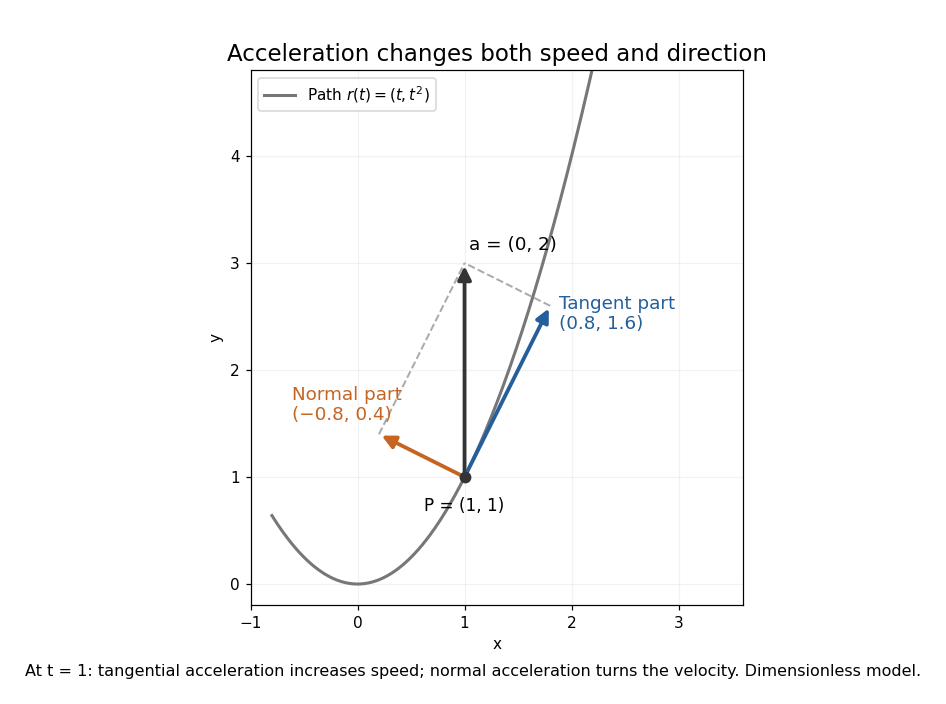

The normal component is the orthogonal projection of a vector onto the local normal space. For a hypersurface with unit normal , the vector component is ; the signed scalar component is . These two meanings must be distinguished. With the principal normal vector chosen toward the turning side of a curve, the normal scalar coefficient of acceleration is .
The tangential component is the orthogonal projection of a vector onto the tangent space. For a plane curve, it is ; for a hypersurface, it is . The scalar tangential component of acceleration is , which can be positive, zero or negative as the speed increases, remains constant or decreases.
The normal derivative of a differentiable function along a hypersurface with unit normal is the directional derivativeHigher normal derivatives at a point may be defined by differentiating the one-variable function repeatedly at .
For a divergence-form differential operator , its conormal derivative is the flux factor appearing in integration by parts. It generally differs from the ordinary normal derivative when is anisotropic. Decomposing the gradient along a smooth boundary into its normal and tangential components gives in two dimensions. Thus zero normal derivative does not in general remove the boundary term in the usual symmetric weak formulation. A zero conormal derivative does remove it and produces the natural homogeneous Neumann boundary condition for that energy.
Articles by others on the same topic
There are currently no matching articles.