Solution
ID: past-exam-of-the-mathematics-course-of-the-university-of-cambridge/2013/iii/paper-55/2/solution
Past exam of the mathematics course of the University of Cambridge 2013 iii Paper 55 2 Solution by  Codex 0 Created 2026-10-03 Updated 2026-10-14
Codex 0 Created 2026-10-03 Updated 2026-10-14For a pressureless spherical mass shell with fixed enclosed mass and no shell crossing, the shell theorem gives . A cosmological constant is absent in the Einstein-de Sitter universe. Parametric differentiation givesSince , the equation of motion holds providedThe expanding branch runs from to the turnaround of spherical collapse ; the recollapsing branch runs from to . HenceThe common bang-time origin selects the growing overdensity, without an extra arbitrary shift in the time parameter.
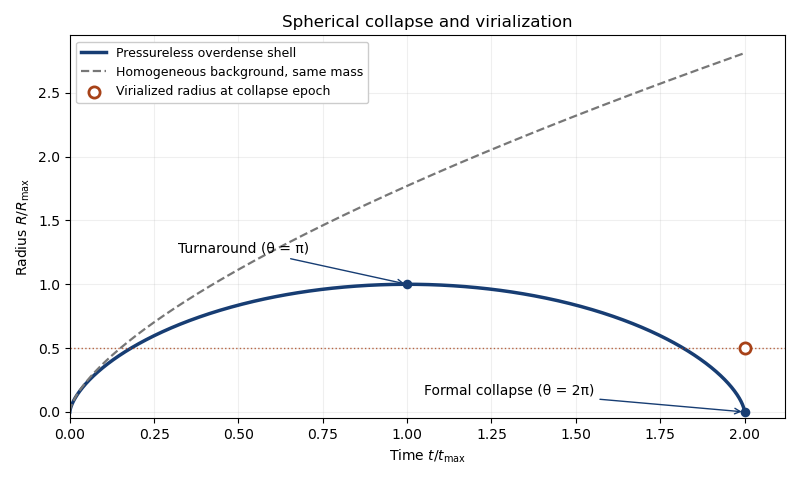

In the Einstein-de Sitter universe, and . An unperturbed homogeneous sphere containing the same mass thus has . Comparing its volume with the perturbed sphere givesAt maximum expansion,For the non-dissipative, homologous spherical-collapse model, the potential energy of a uniform sphere is . At turnaround the bulk kinetic energy is zero, so . At virial equilibrium, gives . Conservation of energy implies , and therefore . This comparison assumes the same potential-energy structure coefficient; it is the usual top-hat model rather than an exact claim about every halo profile.
Halving the radius multiplies the density by eight. During the interval to , the background density falls by four. ThusThe formal pressureless trajectory reaches zero radius; the physical virialized object instead has a finite radius. Its density is evaluated at the same collapse epoch, not at the instantaneous singular solution's density.
For a physical estimated virial radius and enclosed mass, . Equating this to gives a halo density estimate of formation redshift:In the pure Einstein-de Sitter universe, equals the present critical density. The inference assumes the measured density retains the collapse-epoch normalization. Later accretion, mergers and a changing virial-radius convention can change it, so it is a model-dependent formation estimate rather than a unique historical date.
New to topics? Read the docs here!