This is the density threshold in the Friedmann equation for spatial flatness; thermodynamic and plasma critical densities are different concepts.
The mass-density convention for the cosmological critical density. If denotes energy per unit volume, and . Both conventions give the same dimensionless density parameter when numerator and denominator use consistent units. This distinction avoids inserting an extra into a Friedmann equation written in terms of mass-equivalent density.
The density parameter is . In a Friedmann universe, its departure from one measures the spatial-curvature term relative to the density or expansion term.
The Friedmann equation relates this ratio to spatial curvature and the expansion rate; the parameter and the evolution equations are distinct concepts.
At maximum expansion of a closed matter-dominated Friedmann solution, the Hubble parameter vanishes while the physical mass density stays positive and finite. Its critical density therefore vanishes and the cosmological density parameter diverges. This is a singularity of that ratio rather than a curvature singularity. In the cycloid variable , , diverging at and approaching one at the Big Bang and Big Crunch ends.
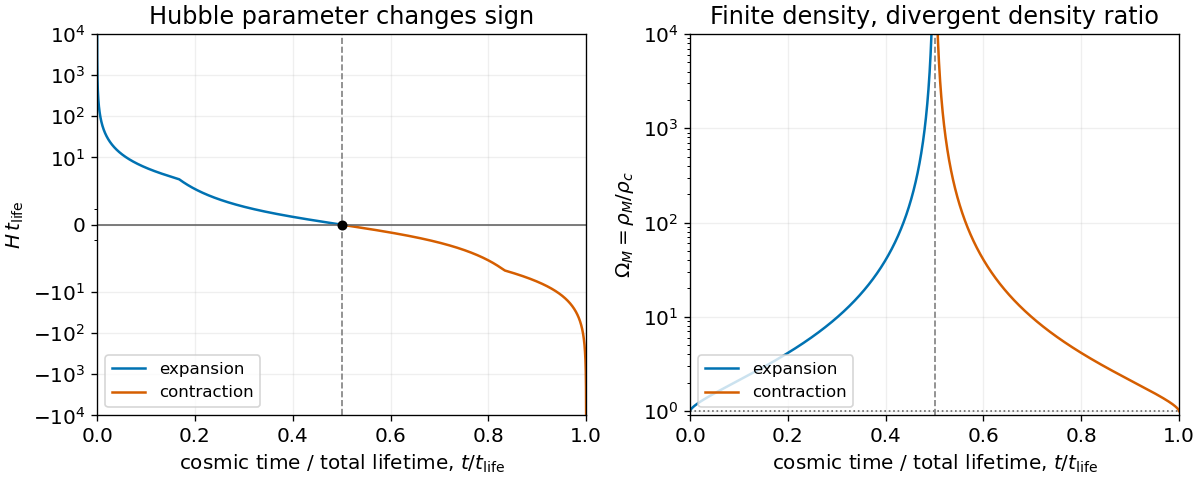
A closed dust universe: the Hubble parameter changes sign while its density parameter diverges at maximum expansion
. Details. 
The matter density parameter is the ratio of total nonrelativistic matter density, including baryonic and dark matter, to the critical density at the same epoch. A present-epoch value uses and . It is not the total cosmological density parameter when radiation or vacuum energy also contributes.
For physical density and conformal time, . Substitution into the definition gives the displayed formula. Omitting gives , which need not equal one even in a spatially flat matter-only universe. In particular, the conformal growth source equals with the physical density parameter.
The cosmic baryon fraction is the ratio of mean baryonic matter density to total matter density. Assigning this fraction to a halo is a simplifying assumption; cooling, ejection and other baryonic processes can change the halo's retained gas and stellar fractions. A baryon conversion efficiency becomes a stellar-to-total-halo mass ratio only after multiplying by the applicable baryon fraction.
If a measured cluster baryon fraction represents the cosmic baryon fraction , combining it with the cosmological baryon density inferred from Big Bang nucleosynthesis gives the displayed estimate. Gas and stellar baryons must both be counted, and all distance or Hubble constant dependence must be consistent. Baryon depletion or feedback modifies the identification: with , the corrected answer is . The method measures total matter rather than vacuum or radiation density.
For an expanding Friedmann-Lemaître-Robertson-Walker metric with positive energy density, put and , in units . The Friedmann equation, Friedmann acceleration equation and cosmological perfect-fluid continuity equation giveFor constant , linearizing at gives . For variable , replace the power by . This describes the flatness problem for decelerating expansion, away from epochs at which .
For separately conserved pressureless matter, . The deceleration parameter identity and give . A dust-plus-vacuum universe has ; conversion to conformal time yields the displayed flow. The familiar matter-only equation requires negligible cosmological constant. In a spatially flat dust-plus-vacuum universe, and , so flatness does not require .
In a decelerating expanding universe, grows, so its small present value requires extremely fine-tuned early initial data unless an earlier mechanism drives toward one.
For positive slope parameter , the exponential-potential field increases during cosmic inflation. The quantity grows by with constant and . Starting from order-one curvature and demanding order-one or smaller present curvature gives the displayed upper bound on the initial field. A specified tighter final curvature tolerance adds one-half its logarithm to the numerator. Thus sufficient cosmic inflation sets an upper, not a lower, initial-field bound for this sign of the potential slope. Instantaneous reheating and subsequent entropy conservation determine .
Articles by others on the same topic
There are currently no matching articles.