Solution
ID: past-exam-of-the-mathematics-course-of-the-university-of-cambridge/2013/iii/paper-69/3/solution
Past exam of the mathematics course of the University of Cambridge 2013 iii Paper 69 3 Solution by  Codex 0 Created 2026-10-03 Updated 2026-10-14
Codex 0 Created 2026-10-03 Updated 2026-10-14Take increasing upslope and let be the superficial Darcy velocity, so the mobile discharge is . Its pore transport speed is . This interpretation is required by the factors of porosity in the printed equations; a literal pore-speed convention would instead replace there by .
For capillary residual trapping, let be the maximum invaded thickness, including the initial state. The stored carbon-dioxide volume per plan area isDuring advance, and new pores fill with mobile carbon dioxide; during recession, is fixed and the newly vacated pores retain saturation . Conservation of mobile plus trapped fluid isConsequentlyAssume and . The two speeds differ because the advancing front fills a whole pore volume while the receding tail removes only its mobile fraction.
The method of characteristics keeps height constant on on the leading face and on the trailing face. Matching the two linear profiles gives the triangular current with capillary retention:Before extinction, the rear, front, crest position and crest height areEvery positive height has one trailing and one leading characteristic; their intersections trace the crest. The mobile current disappears at
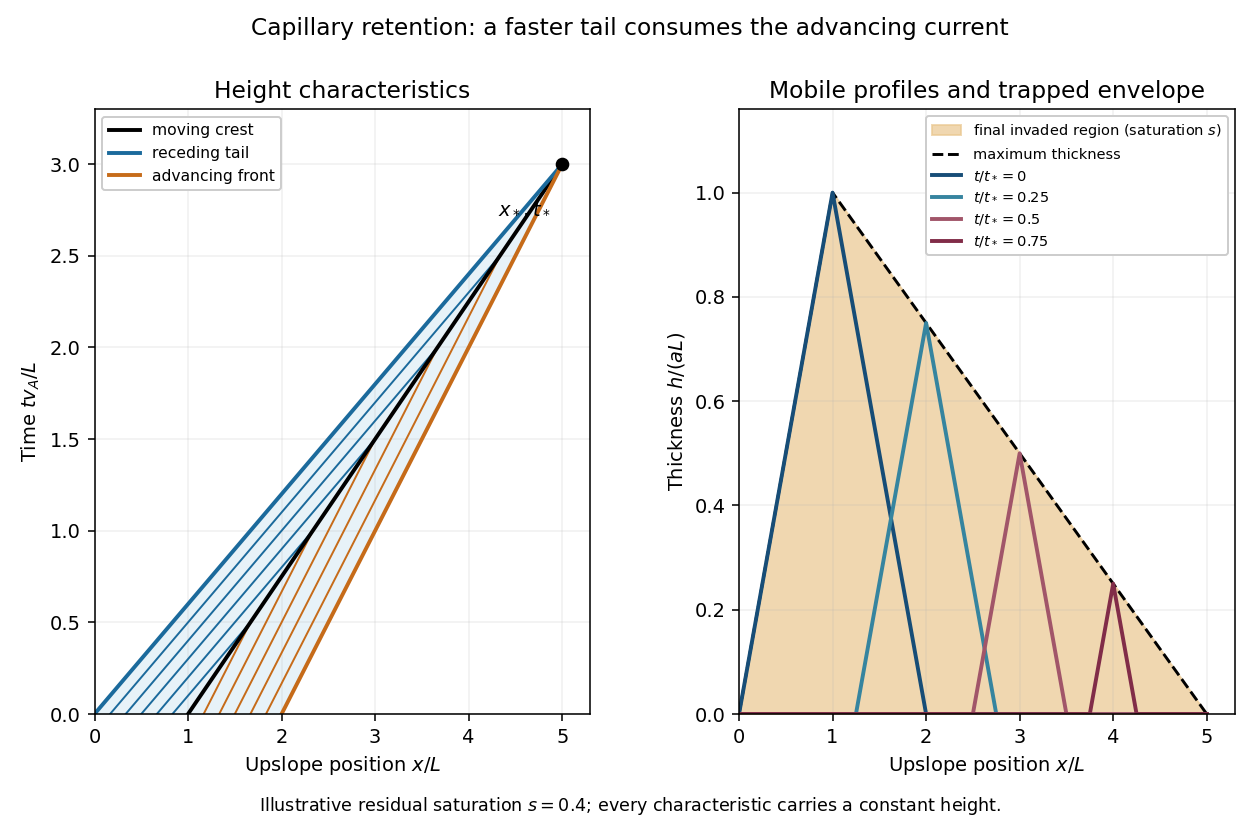
Advancing and receding characteristics, shrinking mobile profiles, and the final capillary trapping envelope
. Details. 
The final trapped region is the maximum-invasion envelope of a retained current. For , the initial height is already the maximum, . For , the maximum occurs when the crest passes , at . Substituting into the trailing profile givesIf is distance into the aquifer measured normally from its upper boundary, trapped carbon dioxide occupies at residual pore saturation . The occupied pore volume per unit transverse width isexactly the initial mobile volume. This is an independent mass-conservation check of both the envelope and extinction distance. In the limit , the current translates without shrinking and nothing is trapped; the finite-extinction formula is not used in that limit.
New to topics? Read the docs here!