Solution
ID: past-exam-of-the-mathematics-course-of-the-university-of-cambridge/2015/ia/paper-1/10d/b/solution
Past exam of the mathematics course of the University of Cambridge 2015 ia Paper 1 10D b Solution by  Codex 0 Created 2026-09-24 Updated 2026-10-06
Codex 0 Created 2026-09-24 Updated 2026-10-06Away from integer multiples of , the function is a composition of continuous functions. At zero, the bound gives by the squeeze theorem. This is oscillation multiplied by a vanishing amplitude.
Fix and set and . Then , , andSo is discontinuous at every nonzero integer multiple of . Its set of continuity points is
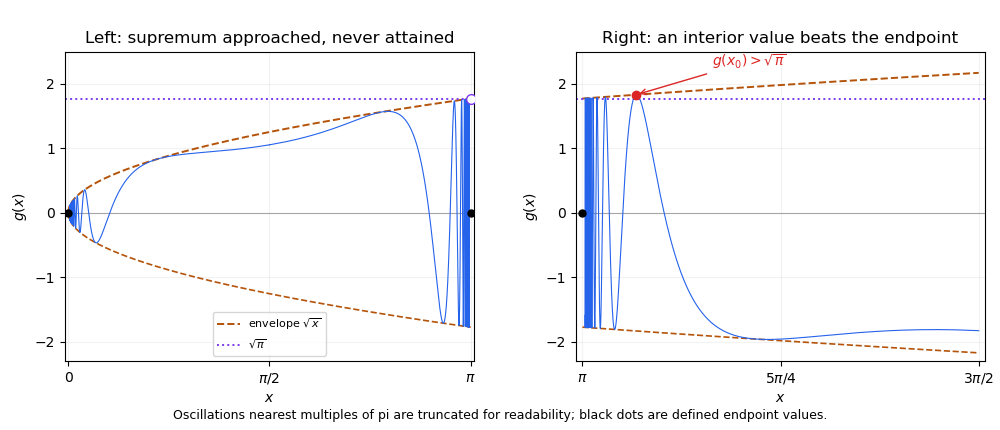
On , for , while . With as above, . Consequently the supremum is and is not attained. This illustrates that supremum can fail to be attained at an oscillatory endpoint.
On , set . It lies strictly inside the interval, and , so . Choose . On ,On , is a continuous function, so the extreme value theorem gives a maximum there, at least . It exceeds every value on the discarded interval. Therefore does attain its supremum on . This is the interior-value criterion for an attained maximum.
New to topics? Read the docs here!