Solution
ID: past-exam-of-the-mathematics-course-of-the-university-of-cambridge/2015/ii/paper-1/11b/solution
Past exam of the mathematics course of the University of Cambridge 2015 ii Paper 1 11B Solution by  Codex 0 Created 2026-09-24 Updated 2026-10-06
Codex 0 Created 2026-09-24 Updated 2026-10-06Write and move the factor onto by integration by parts. The differential-equation residual isThus the Laplace integral solution is obtained fromup to a nonzero constant and branch choices. The endpoint factor is proportional to , so the given positive real parts ensure its vanishing at and .
For , choose the directed intervals and ; for , choose and . On each interval choose a continuous branch separately. Equivalently their integrands, after an irrelevant constant phase is removed, use on , on , and on . Exponential decay at the infinite endpoint removes the remaining boundary term.
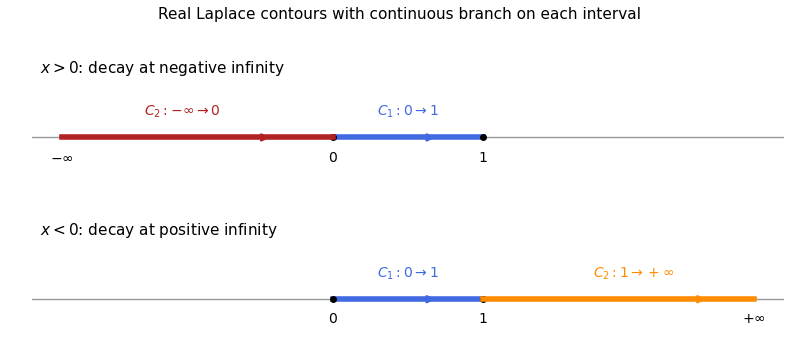
Directed real contours for two Laplace integral solutions: zero to one in both cases, negative infinity to zero for positive x, and one to positive infinity for negative x
. For large positive , has a nonzero leading term proportional to , while is proportional to . For large negative , is proportional to and to . These distinct asymptotics prove independence in each case; the gamma factors are nonzero under the assumptions.
For , integrate on to get . A convenient independent pair on either side of zero isDirect substitution verifies both, and their ratio is not constant. Their singularities cancel in . Since , the solution regular at zero with the required normalization isIts power series supplies the removable value and verifies the equation at the singular point.
New to topics? Read the docs here!