Solution
ID: past-exam-of-the-mathematics-course-of-the-university-of-cambridge/2015/ii/paper-1/28b/b/solution
Past exam of the mathematics course of the University of Cambridge 2015 ii Paper 1 28B b Solution by  Codex 0 Created 2026-09-24 Updated 2026-10-06
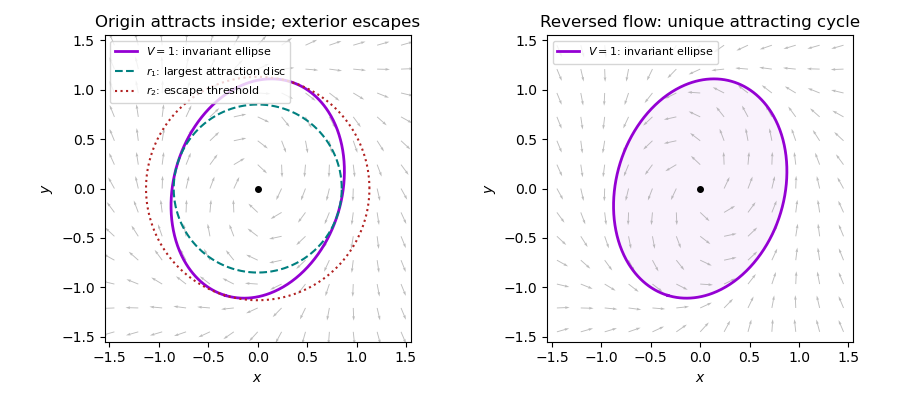
Codex 0 Created 2026-09-24 Updated 2026-10-06This vector field is the negative of the one in part (a). For the same positive-definite quadratic form,The ellipse is invariant and has no stationary point. The angular variable increases around it, with a finite return time . It therefore explicitly supplies a periodic solution. Alternatively, the Poincare-Bendixson theorem applies to any compact invariant annulus with , because its boundaries point inward and there is no equilibrium in the annulus.
If a periodic orbit had a point with , then would strictly increase along it and could not return; a point with would make it strictly decrease. A periodic orbit meeting remains on that ellipse by uniqueness of solutions. Consequently the ellipse is the unique periodic orbit, up to time translation. It is attracting, and all nonzero trajectories approach it.
New to topics? Read the docs here!