Solution
ID: past-exam-of-the-mathematics-course-of-the-university-of-cambridge/2015/iii/paper-53/4/iv/solution
Past exam of the mathematics course of the University of Cambridge 2015 iii Paper 53 4 iv Solution by  Codex 0 Created 2026-10-03 Updated 2026-10-06
Codex 0 Created 2026-10-03 Updated 2026-10-06Write for the dimensionless power spectrum. A radiation-era mode enters the horizon at . The early superhorizon law gives : the and factors cancel.
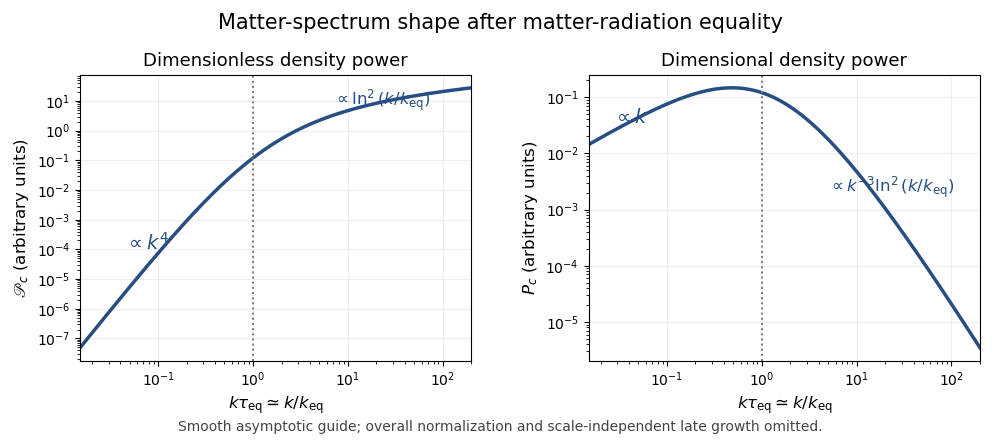
For , the mode remains outside the horizon throughout the radiation era. Its amplitude grows as both before and after equality, and continues with the same scale-independent growing factor even if it later enters during matter domination. Hence the low-wavenumber shape is preserved:For , horizon entry occurs during radiation domination. Its subsequent logarithmic amplitude growth supplies a factor by equality. During the matter era the amplitude grows by . Squaring gives the logarithmic high-wavenumber density-spectrum transfer:The horizon-entry and equality matching fixes order-one coefficients and additive constants inside the logarithm. The displayed branches capture the requested leading spectrum and share its schematic normalization; their asymptotic forms must not be joined literally at , where the high- logarithm alone vanishes.
Thus the present dimensionless power spectrum rises as on large scales and only as on small scales, with a smooth bend near the matter-radiation equality scale, . The ordinary dimensional cosmological density power spectrum instead satisfiesIt has a turnover near equality; the dimensionless spectrum does not. The following comparison of dimensional and dimensionless matter spectra across equality uses a smooth guide with the correct asymptotes, not an exact solution through the transition. Overall vertical normalization and the later scale-independent growth factor are suppressed.
New to topics? Read the docs here!