
A wavenumber measures how rapidly a wave phase changes with distance. Two conventions coexist: angular wavenumber counts radians per unit length, while ordinary spatial frequency counts cycles per unit length. For a monochromatic wave with wavelength ,Here is the magnitude of the angular wavenumber. The symbol can instead denote a signed one-dimensional angular wavenumber: a factor has wavelength for real . Both conventions have dimensions of inverse length; writing or “cycles per metre” exposes the convention. A quoted value in alone does not resolve the factor of . Spectroscopic wavenumber usually uses the cycles-per-length convention.[ref]
University Physics Volume 1. section 16.2, equations 16.2–16.5: angular convention and sinusoidal wave phase
For a real monochromatic plane wave, fix the conventionThe wavevector supplies both the spatial wave phase slope and the normal to the wavefronts; its dot product with position makes the wave phase constant on parallel planes. The angular frequency is , with the ordinary frequency. Moving a distance along changes the wave phase by . Holding a wave crest's wave phase fixed gives its phase velocity and phase speedIn one dimension the signed phase velocity is . This identifies a moving pattern; it does not identify the motion of the medium's particles or a wave packet's group velocity.
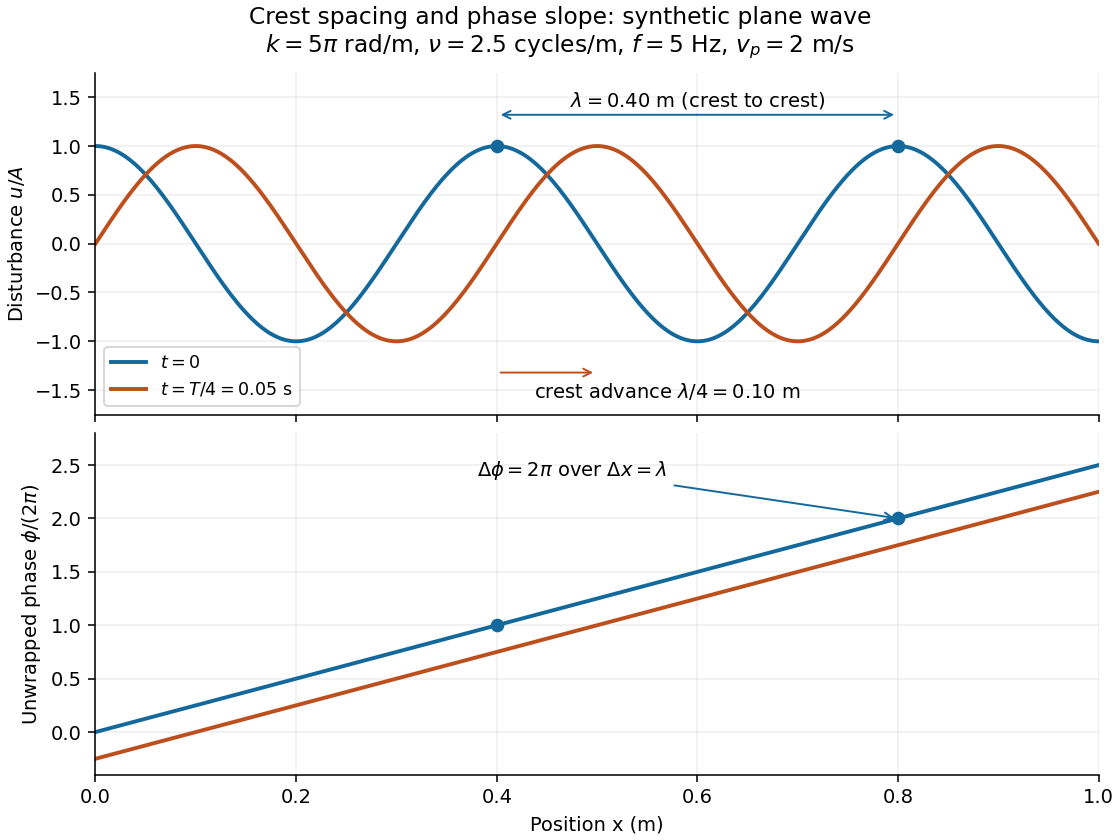
For the synthetic plane wave below, choose and . Then , cycles per metre, , and . The wave crests are apart at one instant; after a quarter oscillation period, each has advanced . The lower panel retains whole turns of wave phase, making its slope visible instead of reducing it modulo .


Wavenumber is a measure of the number of wavelengths per unit distance and is used in various fields such as physics, chemistry, and optics. It is defined as the reciprocal of the wavelength and is usually expressed in units of reciprocal length, such as inverse meters (m⁻¹).
New to topics? Read the docs here!