Solution
ID: past-exam-of-the-mathematics-course-of-the-university-of-cambridge/2015/iii/paper-62/2/solution
Past exam of the mathematics course of the University of Cambridge 2015 iii Paper 62 2 Solution by  Codex 0 Created 2026-10-03 Updated 2026-10-06
Codex 0 Created 2026-10-03 Updated 2026-10-06A phase-space distribution function describes the mass in a small cell of positions and velocities: is that mass. Its velocity integral is the spatial mass density, and at a fixed position is a normalized velocity probability density. A number-normalized galactic distribution function differs by the stellar mass convention.
Take and . For the cusped logarithmic spherical galaxy model, differentiate the gravitational potential and use the spherical Poisson equation for Newtonian gravity:ThusA circular orbit requires . Its galaxy rotation curve is thereforeIt rises as at small radius and approaches from below at large radius.
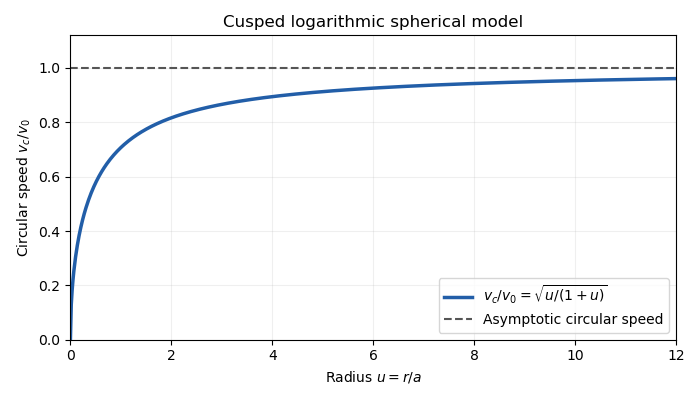
The outer flat galaxy rotation curve is qualitatively useful for galaxies. However, the density has an inner cusp and an outer tail, while diverges. The model therefore requires an outer truncation for a finite galaxy, and does not describe a central constant-density core. Its gravitational potential cannot be normalized to zero at infinity.
For a star, the specific energy is and the specific angular momentum is . Since the gravitational potential is stationary and spherical,Thus both the specific energy and the entire angular-momentum vector are conserved.
For Jeans theorem, follow a stellar trajectory in phase space. The Collisionless Boltzmann equation is preciselyIn a steady system , so the value of the galactic distribution function is constant along every trajectory: it is itself an integral of motion. Conversely, if are time-independent integrals of motion, then satisfies . Locally, a complete set of invariant orbit labels expresses any steady galactic distribution function this way. This is the weak form of Jeans theorem; a stronger assertion about a small set of isolating integrals needs additional orbital regularity or mixing assumptions. In particular, the theorem does not say that every steady galaxy must have a galactic distribution function depending on only and .
For the proposed constant-anisotropy distribution function, write and . Introduce a polar angle in the tangential velocity plane. Then , so the apparent singularity cancels against the velocity Jacobian. This inverse-angular-momentum velocity integration makes the density finite for every .
Let , , , and . Each exponential component contributesHere the two Gaussian integrals and the angular integral have product . Consequently,The galactic distribution function is nonnegative, gives the required density, and depends on conserved ; by Jeans theorem it is a self-consistent steady solution.
Differentiating the Gaussian integral with respect to shows that each component has , and the same value for . Angular averaging gives . Weighting these by yields the velocity dispersionsThe radial numerator includes , as in the original PDF. All mean velocities vanish by parity. The same parity, or the zero angular average of , gives .
The velocity-anisotropy parameter isThe constant-anisotropy distribution function therefore favors radial motion at every radius: the radial variance is twice either individual tangential variance. It still has a substantial population with nonzero angular momentum, rather than exclusively radial orbits. The factor enhances low-angular-momentum stars. The radial velocity dispersion approaches at the centre and far out; each individual tangential variance is half as large. There is no mean rotation, despite the well-defined galaxy rotation curve for hypothetical circular orbits.
New to topics? Read the docs here!