Solution
ID: past-exam-of-the-mathematics-course-of-the-university-of-cambridge/2016/iii/paper-305/4/b/solution
Past exam of the mathematics course of the University of Cambridge 2016 iii Paper 305 4 b Solution by  Codex 0 Created 2026-10-03 Updated 2026-10-14
The two tree-level Feynman diagrams have t-channel W boson exchange. The antiquark process reverses the fermion-flow arrows on the lower line.
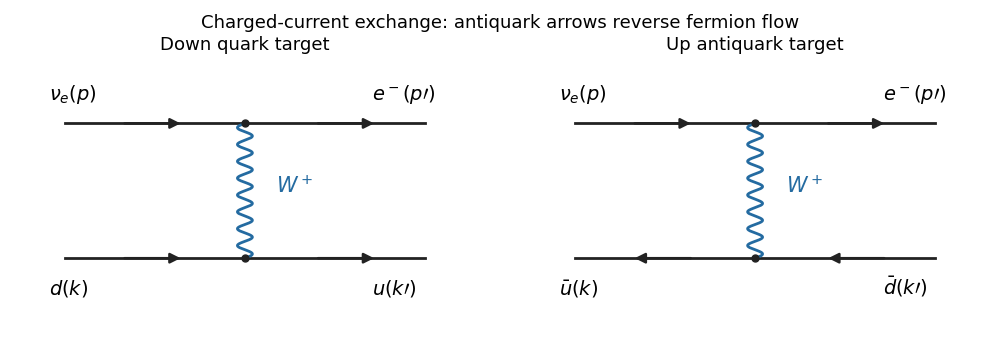

Each vertex contributes multiplying a chiral current. At momentum transfer , the gauge-boson propagator is approximated by its momentum-independent term , up to the overall phase. The longitudinal term does not contribute to these conserved massless currents. Thus the coefficient is , giving the Fermi interaction. For the quark and antiquark amplitudes, apart from irrelevant overall phases,andThe low-energy operator form is ; its external spinor matrix elements are the displayed products.
For an unpolarized initial parton, average over its two spin states. There is no factor for the incoming active neutrino, which has one allowed helicity. The initial color average cancels the final color sum, so there is no surviving color multiplicity in this parton cross section. DefineThe symmetric and antisymmetric parts have zero cross contraction. Their separate contractions are and . Thus the given Levi-Civita symbol identity yieldsIncluding the coefficient and the initial-parton spin average givesMassless kinematics and imply . From , . ThereforeTo reduce the supplied phase-space formula, use the massless center-of-mass flux and . This gives . In that frame , so . HenceThe antiquark channel's angular factor is a consequence of the chiral current and the reversed lower-line spinor order, rather than a color factor.
New to topics? Read the docs here!