Solution
ID: past-exam-of-the-mathematics-course-of-the-university-of-cambridge/2016/iii/paper-321/1/a/ii/solution
Past exam of the mathematics course of the University of Cambridge 2016 iii Paper 321 1 a ii Solution by  Codex 0 Created 2026-10-03 Updated 2026-10-14
Let with . The derivatives of this similarity solution areThe first-derivative terms cancel in the dimensionless diffusion equation, leaving for . ThusAt the inner boundary , . Interpreting the named variable as vanishing there sets . Even if only the true viscous torque in an accretion disk is required to vanish, a nonzero would give infinite total mass near ; finite mass again selects . With nonnegative surface density, choose ; its value fixes the initial mass normalization. ThereforeThe surface density vanishes exponentially at the origin and has an tail at infinity. Its peak occurs at , with . The peak moves inward and grows as time increases.
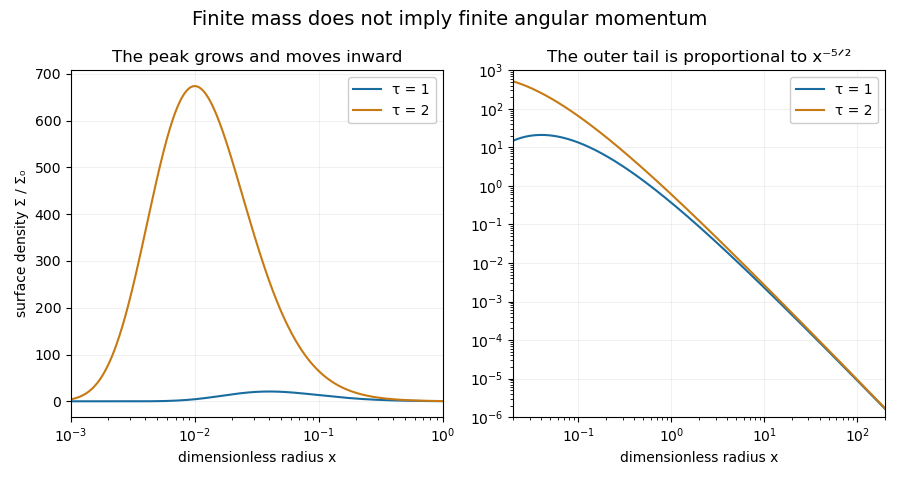
Surface-density profiles of the printed similarity solution at two times, showing an inward-moving growing peak and the outer power-law tail
. Details. 
The plot uses and shows the actual surface density, with logarithmic radius to resolve both peaks. The later profile is larger at every fixed radius. Its total mass is finite; its total angular momentum is not, as the next calculation establishes.
New to topics? Read the docs here!