Solution
ID: past-exam-of-the-mathematics-course-of-the-university-of-cambridge/2017/ii/paper-1/35d/solution
Past exam of the mathematics course of the University of Cambridge 2017 ii Paper 1 35D Solution by  Codex 0 Created 2026-09-24 Updated 2026-10-06
Codex 0 Created 2026-09-24 Updated 2026-10-06Use a Lorentz boost along positive with . Since , its dimensionless speed is less than one. The given transformation of the electric field and magnetic field yields andAll other electric components vanish. In this frame a magnetic field does no work, so the particle's speed and Lorentz factor are constant. In proper time, the Lorentz force equations are and . Thus, choosing the phase and origin,This is the signed proper-time cyclotron frequency; the frequency with respect to is . The inverse Lorentz boost givesIn particular the average drift speed is along .
For , , set and . The dimensionless spatial curve isThe drift between successive cycles is . When , this is small compared with the oscillation size: the curve consists of nearly closed loops with slow rightward drift. When , the longitudinal drift is large, producing a progressing oscillatory curve. More precisely : loops occur for , cusps at , and monotone progression for . The stated large-drift inequality compares the drift over a full cycle, so an example of that regime with is shown; that comparison alone does not replace the exact loop criterion.
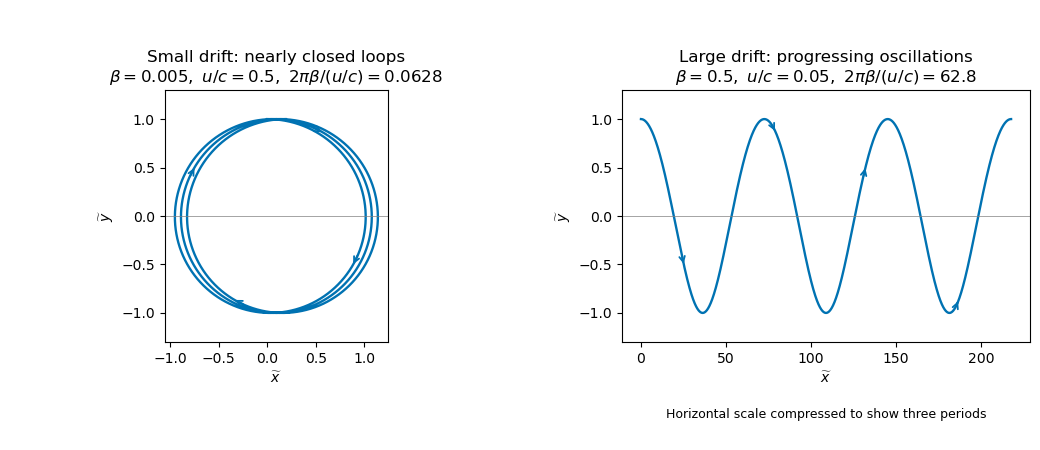
The relativistic drift of a charged particle
. Reversing reverses the cyclotron orientation; the drift remains along positive . If the trajectory is pure straight drift and the dimensionless coordinates are undefined. If the particle is inertial and the displayed parametrization must be replaced by its inertial limit.
New to topics? Read the docs here!