Solution
ID: past-exam-of-the-mathematics-course-of-the-university-of-cambridge/2018/iii/paper-305/3/c/solution
Past exam of the mathematics course of the University of Cambridge 2018 iii Paper 305 3 c Solution by  Codex 0 Created 2026-10-03 Updated 2026-10-14
The tree-level Feynman diagrams contain an unchanged spectator quark, of up quark flavour and the two possible weak charged current transitions of the charm antiquark:
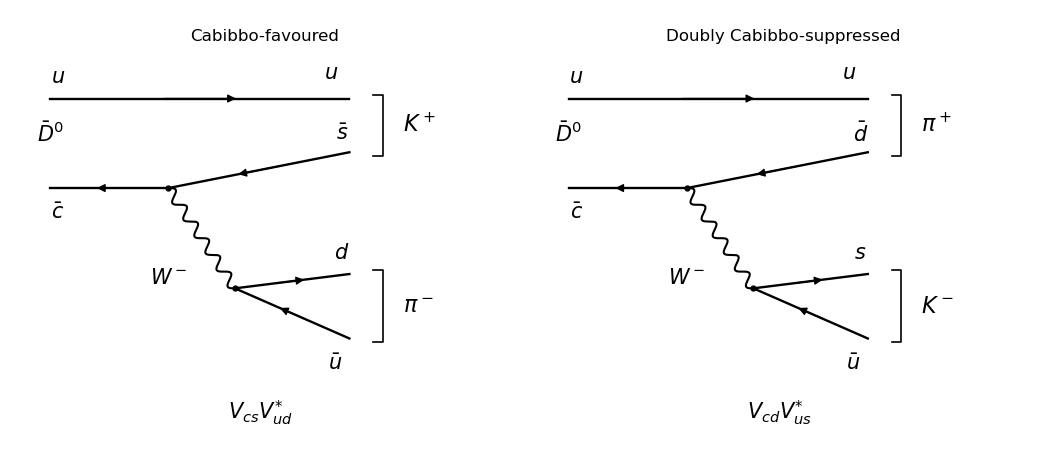

For , and . The spectator quark combines with into the kaon , while forms the pion . The Cabibbo-Kobayashi-Maskawa matrix factor is .
For , and . The spectator quark combines with into the pion , while forms the kaon . The Cabibbo-Kobayashi-Maskawa matrix factor is .
Neglecting neutral D-meson mixing and assuming comparable strong interaction matrix elements, the relative direct decay widths areHere is the Cabibbo angle. The second process is doubly Cabibbo suppressed: it contains two small Cabibbo suppression factors in its amplitude. The Cabibbo angle estimate assumes similar Quantum chromodynamics matrix elements; it is not an exact rate equality.
New to topics? Read the docs here!