Quantum chromodynamics, or QCD, is the non-Abelian gauge theory of quarks and gluons. Quarks transform in the fundamental color representation and the eight gluon fields in the adjoint representation. The non-Abelian field strength generates gluon self-interactions as well as quark–gluon interactions.
The strong coupling constant changes with scale: it becomes small at sufficiently high energies, permitting perturbative predictions, and grows toward the QCD scale. Low-energy color confinement and hadron structure are therefore not obtained by extrapolating a few weak-coupling diagrams without qualification. Parton distribution functions describe the long-distance input needed for many hard hadron-scattering predictions. Jets connect the calculated energetic partons with measured sprays of color-neutral particles after hadronization.
Expanding gives a vertex joining a quark, its conjugate line and a gluon. In the convention , its rule is the displayed matrix. The gluon changes the color charge state through the generator but preserves the quark flavour. With distinct flavours in , this permits the tree-level annihilation graph but not a flavour-changing exchange along one quark line.
For distinct incoming and outgoing quark flavours, tree-level has one gluon annihilation graph. Averaging the initial colours gives , and averaging initial spins gives . The outgoing fermion spin sum must use distinct particle and antiparticle projectors. For final mass , and the displayed result includes all outgoing colour and spin sums. Its amplitude squared remains finite at threshold even though the cross section vanishes through the final-state velocity.
For Hermitian fundamental representation generators normalized by , the Abelian-shaped one-loop Feynman diagram has colour factor . Expand to prove the identity. With oriented structure tensor , the three-gluon graph has by antisymmetrizing the generator product. The factor and its sign must be combined consistently with the chosen three-gluon Feynman rule. For , the two real coefficients are and .
For massless distinguishable quarks exchanging one gluon, summing the squared generator contraction gives two with . Averaging nine initial colors and four initial spins leaves the coefficient multiplying the two Dirac traces. Their contraction is , yielding the displayed tree-level result. Identical quarks require an additional exchange amplitude and its interference.
Lattice QCD is a lattice gauge theory formulation of quantum chromodynamics. A Euclidean path integral on a discrete spacetime lattice provides a route to computing hadron observables numerically, particularly when weak-coupling expansions are inadequate. Physical predictions require control of lattice spacing, finite spatial volume and quark-mass effects.
The gauge-covariant kinetic term for two massless quarks separates into left- and right-handed parts. Independent constant unitary quark flavor rotations preserve these terms, giving classical internal symmetry in addition to local color . The singlet axial has a chiral anomaly, while the nonsinglet chiral symmetry and vector baryon number remain exact quantum symmetries, up to their shared discrete identifications. Equal nonzero quark masses reduce the continuous flavor symmetry to .
A collimated collection of final hadrons associated with an energetic parton and its radiation and hadronization. A precise perturbative prediction requires an infrared-safe observable that specifies how particles are grouped into jets.
In inclusive electron-positron annihilation into hadrons, hard gluon radiation produces a quark, an antiquark and a gluon, giving three resolved particle jets. Observation of such events at PETRA in 1979 provided direct evidence for gluons. The institutional account is www.desy.de/news/news_search/index_eng.html?openDirectAnchor=1643&printversion=1 .
For an infrared-safe observable, loop corrections and integrated unresolved real emissions have compensating infrared divergences and collinear divergences. Keep a common regulator until they are added. At the first QCD correction to photon-mediated quark production, virtual gluon exchange corrects the two-parton state and real emission supplies the three-parton state. Their inclusive sum is finite after ultraviolet renormalization; resolved three-jet rates additionally depend on an infrared-safe resolution prescription.
Hadronization is the conversion of colored quarks and gluons into color-neutral hadrons. It affects exclusive final-state distributions even when an inclusive observable can be approximated through a short-distance partonic calculation. A tree-level partonic decay width does not by itself model this conversion.
A characteristic proper timescale for strong bound-state formation, estimated by dimensional analysis from the QCD scale. A scale of a few tenths of a GeV corresponds to a few . It is an order-of-magnitude guide rather than a universal sharply defined formation time.
Quark-hadron duality is the correspondence, in suitable inclusive or averaged observables, between a quark-level description and a sum over hadronic states. Asymptotic freedom supports perturbative short-distance production, but sharp resonances and threshold regions can invalidate a pointwise partonic approximation. Inclusive predictions can have both radiative and nonperturbative corrections.
In the large-color limit of QCD with fixed, baryon masses scale as while meson masses remain of order one. A Skyrme model action with coefficients of order has soliton mass and rotational moment of inertia of order , and rotor splittings of order . This motivates a semiclassical mesonic description of baryons; it does not uniquely determine every term in a finite-color effective theory.
The strong coupling constant parametrizes the strength of Quantum chromodynamics interactions. Its dependence on the renormalization scale is governed by the renormalization-group beta function. It is dimensionless in four dimensions.
Color charge is the gauge group charge of Quantum chromodynamics, associated with its symmetry. A quark transforms in the fundamental three-dimensional representation, an antiquark in its conjugate, and a lepton is a singlet. The word color is a label for this charge, unrelated to visible light.
The group-theoretic tensor multiplying the kinematic part of a Feynman diagram involving color charge. It is obtained by contracting internal indices among gauge generators, invariant tensors and structure constants of a Lie algebra. For instance, one gluon exchange on a single quark line contributes ; averaging or summing the squared tensor over external colour labels gives the corresponding color average in a squared scattering amplitude.
A quark-gluon Feynman vertex whose initial and final quark have the same chosen color charge basis label. Such vertices exist: the diagonal Gell-Mann matrices act nontrivially on the red basis vector. Their gluons are traceless colour-octet combinations, not colour singlets. A ninth singlet generator proportional to the identity is absent from SU(3).
A uniform incoherent initial mixture of two independently prepared fundamental color charges requires an average over their initial possibilities, together with a sum over unobserved final color charges. This differs from preparing a coherent color singlet. For quark-antiquark annihilation through one vector in the adjoint representation, gives . For the exchange contraction , by the SU(N) fundamental completeness relation. The negative overlap reverses the sign of the corresponding Abelian interference term.
In distinct-flavour quark annihilation, the one-photon exchange color charge tensor is , whereas the one-gluon tensor is . Their inner product after the external color charge sum is , since the fundamental gauge generators of are traceless. Thus the averaged squared scattering amplitude has no leading electromagnetic–strong interference term for this process. Fixed external color charge components, or processes with different exchange pairings, need not share this cancellation.
A colour singlet transforms in the trivial representation of the SU(3) colour group. Global colour rotations leave it invariant, and its colour generators annihilate it. A three-quark colour singlet uses the completely antisymmetric colour tensor; a quark–antiquark singlet contracts their colour indices.
For a colorless parent decaying through a color-diagonal interaction into a quark and antiquark, the three orthogonal matching-color states add incoherently. The inclusive flavor decay width is times the one-color width. In a parton scattering rate, an initial color average instead cancels the matching final color sum.
A parton is a constituent resolved inside a rapidly moving hadron by a hard scattering process. In quantum chromodynamics, the relevant partons are quarks, antiquarks and gluons. A parton distribution function describes the momentum-fraction distribution of a specified constituent at a stated resolution scale.
In deep inelastic scattering, a high-energy probe transfers enough momentum to resolve structure much smaller than the hadron. The parton model approximates the short collision as scattering from one constituent, with the remaining structure entering through its distribution. Which partons are resolved depends on the scale; increasing the resolution permits additional radiation and pair production. A parton is therefore not a permanently labeled classical bead inside the hadron, and the distributions are not probabilities for finding isolated free quarks.
The parton model approximates a high-energy collision with a hadron as a short interaction with one constituent carrying a fraction of the hadron's longitudinal momentum. In electromagnetic deep inelastic scattering, the probe couples to charged quarks and antiquarks.
The short collision is treated using a parton-level scattering probability, averaged over parton distribution functions. In the simplest massless collinear limit, the Bjorken scaling variable identifies the struck constituent's momentum fraction, and dimensionless structure functions approximately depend on that variable alone. QCD scaling violation adds logarithmic resolution dependence through radiation and splitting. The model explains why a composite target can display a simple short-distance pattern without requiring its constituents to be permanently isolated classical particles.
In the incoherent massless collinear parton approximation, is the number of quarks in a momentum-fraction interval, not a covariantly normalized external state weight. A single-particle response divided by its external-state normalization is proportional to ; the hadron normalization is . Thus converting a number-weighted parton sum to the target tensor contributes . This gives the displayed convolution, including antiquarks. The spin-averaged electromagnetic parton tensor and then give and , proving the Callan-Gross relation at this order. Target masses, transverse momentum and radiative effects are beyond this leading approximation.
At leading order in the naive parton model, dimensionless deep-inelastic structure functions depend only on Bjorken x. Quantum chromodynamics evolution introduces scale dependence.
Quantum chromodynamics makes parton distribution functions depend on resolution scale through gluon radiation and parton splitting. Thus Bjorken scaling and the linear-energy neutrino cross section are approximate leading-order patterns rather than exact laws.
Dependence of a deep-inelastic structure function on at fixed Bjorken scaling variable. In QCD, radiation and gluon splitting evolve the parton distribution functions with the resolution scale, producing logarithmic departures from the simplest parton model scaling limit.
For massless spin-one-half partons at leading order, the unpolarized electromagnetic deep-inelastic structure functions obey this relation. Radiative quantum chromodynamics corrections and target-mass effects can modify it.
The leading high-energy approximation neglects quark and target masses and transverse constituent momentum. A lightlike reference momentum is used for the hadron; this does not describe a massless particle at rest.
In the leading massless collinear parton approximation, and imply . With Bjorken x and , the Dirac delta change-of-variable formula yields the displayed identity. The positive-energy branch of the final parton also gives locally on physical support. Keeping target mass instead introduces and changes the root and Jacobian.
A parton distribution function specifies a hadron's partonic content as a function of longitudinal momentum fraction and a stated parton factorization scale. In the leading collinear parton model, has a number-density interpretation for partons of species with fractions in . It is not generally normalized to one.
For a proton, the integrals of the valence differences count two net up quarks and one net down quark. A momentum-weighted sum over all quark, antiquark and gluon species gives total momentum fraction one. These are different sum rules. Beyond the simplest approximation, the definition depends on factorization scheme and renormalized field correlations; a naive positive classical probability interpretation is not universal. The functions enter factorized cross sections and evolve with resolution, rather than being predictions of a free-quark model.[ref]
Structure Functions in the 2024 Review of Particle Physics. §18, parton-distribution definitions, sum rules and QCD evolution
A nuclear parton distribution describes parton momentum fractions in a bound nuclear target. Its normalization must specify whether it is per nucleus or per nucleon and how is defined. Nuclear binding, shadowing and other nuclear modifications mean it need not equal a simple sum of free-nucleon distributions.
In the collinear approximation, a parton carries a fraction of its parent hadron's longitudinal momentum. A parton distribution function gives its distribution at the specified factorization scale. For production of one on-shell particle with no transverse recoil, and , where is its rapidity.
For charged current production , charge conjugation of the antiproton distributions gives . With a common sea quark distribution , the valence quark terms are , the mixed terms are , and the two sea assignments give . Omitting the second beam assignment undercounts the pure sea contribution by two.
The approximate equality of proton and neutron parton distribution functions after interchanging up quarks and down quarks, including their antiquarks. It follows from the corresponding isospin symmetry when electromagnetic and light-quark mass-difference effects are neglected. Isospin-singlet sea distributions are unchanged.
The parton distribution function is a number density. Integrating the quark distribution minus the antiquark distribution counts the net flavour charge of the hadron, since every sea quark-antiquark pair contributes zero. The corresponding flavour-vector conserved current counts particles minus antiparticles. For a proton, the net up/down numbers are two and one; for a neutron they are one and two. The rule fixes the difference of distributions, not their sum, and does not imply absence of a sea.
With only up/down valence quarks and no antiquarks, the quark number sum rule and leading parton model expression give the charge-squared number moment . The squared charges are for up and for down, so the proton has and the neutron has . Restricting the flavour list to up/down does not itself remove antiquarks; the no-sea assumption is essential for these individual moments.
The scale at which collinear contributions are assigned to parton distribution functions rather than the hard scattering coefficient. The separate factors depend on this scale, while a consistently calculated physical differential scattering cross-section does not.
Scattering that resolves the constituents of a hadron at large spacelike momentum transfer, with an inclusive sum over final hadron states.
In electron scattering from a proton, write the reaction as : the outgoing electron is measured, while denotes all allowed final hadron states. Large momentum transfer supplies a short-distance probe; a large final invariant mass separates the deep continuum from elastic scattering and individual particle resonances. The useful surprise is that an extended proton can have a response characteristic of much smaller constituents. Deep inelastic scattering turns measurements outside the proton into constraints on its internal parton distribution functions.
The SLAC-MIT deep inelastic electron scattering experiment connects this definition to an actual measurement. Its evidence came from distributions of outgoing electron energies and scattering angles, rather than a photograph of a quark. Bjorken scaling concerns deep-inelastic structure functions after known scattering factors have been accounted for; it does not say that the raw differential scattering cross-section is constant.
In a head-on lepton-proton collision with the proton along , hadronic four-momentum conservation gives and . With , the reconstructed Bjorken scaling variable is . This is useful for charged current events whose final neutrino escapes. Initial-state radiation and unmeasured forward hadrons spoil the ideal closure.
In the operator product expansion for a hard scattering process, twist is operator dimension minus spin. Contributions beyond leading twist describe additional multiparton correlations and are suppressed by powers of the large momentum-transfer scale. A leading-order quark-parton formula omits these power corrections.
For an isoscalar target in the leading massless quark-parton approximation, integrate the two helicity weights over inelasticity: and . Then , where and . Inversion gives the displayed ratio. These are effective weak-flavour momentum fractions; the data do not determine unweighted parton number integrals.
For an isoscalar valence target and massless leading-order scattering, , where . The factor is . With Standard Model quark couplings and , this becomes . Sea quarks and threshold, nuclear and QCD corrections matter beyond this limit.
A nuclear target with equal proton and neutron contributions, or data corrected to that average. Its per-nucleon PDFs are . Charge symmetry gives ; using proton down-quark density alone is not an isoscalar average.
Starting in 1967, a collaboration at the Stanford Linear Accelerator Center and the Massachusetts Institute of Technology directed an electron beam at liquid hydrogen, providing proton targets. Jerome Isaac Friedman, Henry Way Kendall and Richard Edward Taylor participated in this experimental program.[ref]
Deep Inelastic Scattering: Experiments on the Proton and the Observation of Scaling by Henry Way Kendall. 1990 Nobel lecture, section I.A, opening account of the program
The 1969 paper Observed Behavior of Highly Inelastic Electron-Proton Scattering reports inclusive electron spectra at and with incident energies from to . Its scaling comparison estimated under a transverse-virtual photon assumption, finding approximate agreement as a function of for and . These are the paper's conditions, not a claim of exact Bjorken scaling at every momentum transfer.[ref]
A movable magnetic spectrometer selected scattered electrons by momentum and scattering angle. Magnetic fields dispersed momenta at the focal plane. With relativistic electrons, the inferred momentum determines outgoing energy . Commissioning included steering the beam through the spectrometer at zero angle to check its optics and accepted solid angle. Counters sorted events into momentum and angle bins. The acceptance entered the conversion from counts to differential scattering cross-sections.[ref]
Deep Inelastic Scattering: The Early Years by Richard Edward Taylor. 1990 Nobel lecture, Fig. 15, magnet optics; Fig. 33 and adjacent acceptance-calibration account
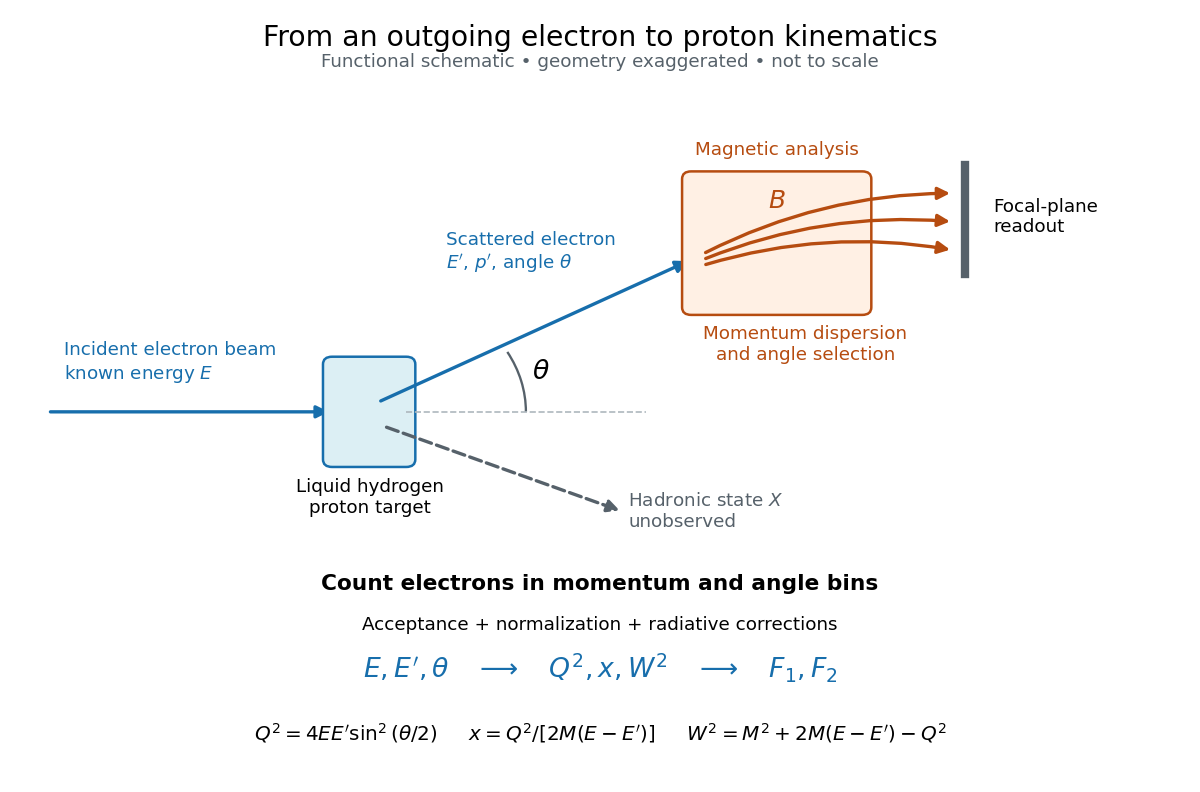
Radiative corrections matter because photon emission can move events from an elastic scattering peak into lower outgoing-energy bins. The analyses subtracted the elastic radiative tail before unfolding inelastic radiation. Independent MIT and SLAC procedures provided a check. An uncorrected low- tail alone therefore cannot establish deep inelastic scattering.[ref]
Deep Inelastic Scattering: Experiments on the Proton and the Observation of Scaling by Henry Way Kendall. Section IV.C, radiative-tail subtraction, unfolding and independent analyses; Figs. 6–8
Work in natural units with , neglect the electron mass, and put the initial proton at rest with mass . Let and be the initial and final electron four-momenta, , and . Define the laboratory energy transfer . This has units of energy; the invariant has units of energy squared. The Bjorken scaling variable and the final hadron invariant mass obeyThese follow by squaring and , using and . Solving the Bjorken x definition gives the outgoing energy and then the scattering angle:Alternatively, substituting before solving gives . A chosen must satisfy and . In addition, must exceed the lightest allowed inelastic hadron threshold; positive alone is insufficient.
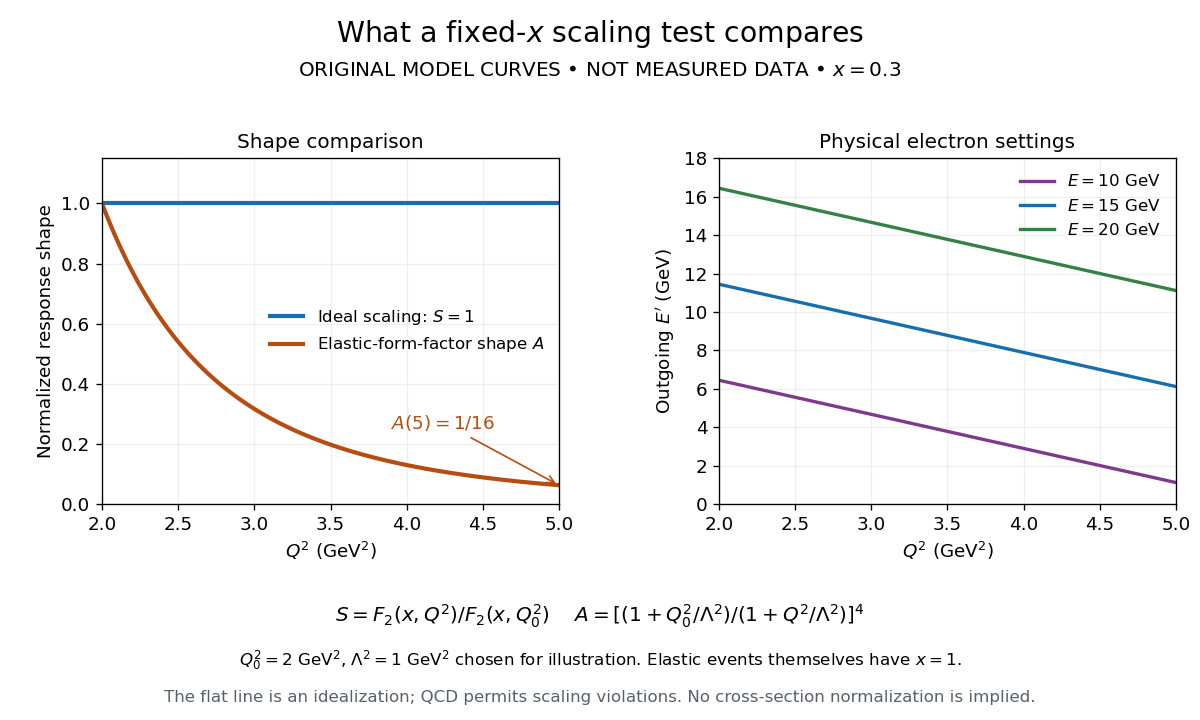
For an original numerical example, take , , and . Then , , , and . Varying and at this same Bjorken x keeps every setting physical and gives , above the proton-pion threshold and the stricter chosen continuum selection . These are calculated settings, not historical measurements.
An ideal Bjorken scaling model has : varying at fixed Bjorken x leaves this dimensionless deep-inelastic structure function unchanged. The comparison requires extracting a deep-inelastic structure function, rather than plotting raw event counts. Quantum chromodynamics predicts departures from exact Bjorken scaling; finite hadron masses also limit the idealization.
For an original shape comparison, choose and define with . The ideal model has . To display a contrasting size-dependent suppression, define an illustrative elastic-form-factor shape with the freely chosen . Its normalized squared magnitude isThus , whereas . The elastic-form-factor shape is a comparison of suppression mechanisms, not an elastic differential scattering cross-section assigned to : actual elastic scattering from a proton has and . Neither curve is measured data or a fit to the SLAC-MIT experiment.
The experimental interpretation required more than a flat curve. The angular dependence and small longitudinal response supported spin one-half partons, expressed at leading order by the Callan-Gross relation . Identification with fractionally charged quarks also drew on later electron, muon and neutrino comparisons. A scaling plot alone does not determine the individual electric charges of constituents.[ref]
Deep Inelastic Scattering: Comparisons with the Quark Model by Jerome Isaac Friedman. 1990 Nobel lecture, identification of the constituents and early neutrino results; 1991 reprint p. 623
The leading parton model formula already shows the ambiguity: combines squared electric charges with unknown parton distribution functions. One measured function cannot independently fix all these quantities. Confinement also explains why an inclusive final hadron state need not contain an isolated outgoing quark.
In deep inelastic scattering, the reference frame where the exchanged virtual photon has zero energy and spatial momentum magnitude .
The inelasticity in deep inelastic scattering is , where is the incoming lepton momentum, the target momentum and the transfer. In the target rest frame it is the fraction of the incoming lepton energy transferred to the target. It is unchanged by replacing by a collinear parton momentum , and in massless kinematics.
In deep inelastic scattering, the scaling variable is with . In the massless collinear parton model, the outgoing on-shell condition identifies with the struck parton's incoming longitudinal momentum fraction.
Here . In the leading massless collinear parton approximation, this kinematic variable equals the momentum fraction of the struck parton.
The inclusive product of hadronic-current matrix elements, summed over final states with a Lorentz-invariant phase-space measure. Electromagnetic current conservation makes both indices transverse to the exchanged four-momentum.
For an absorbed spacelike photon, use , , and the physical momentum delta function . The displayed invariant final mass is compatible with deep inelastic scattering for . Using with the same positive- definition instead gives , which becomes negative in the Bjorken scaling limit and has no physical hadronic spectral support. Reversing the photon convention requires reversing the associated scalar-product and scaling-variable conventions too.
For electromagnetic deep inelastic scattering with an unpolarized target, Lorentz invariance, parity and current conservation leave two independent deep-inelastic structure functions. With and , both tensor structures are transverse to . Terms with a free index disappear on contraction with a conserved leptonic tensor, although such terms can still be necessary to make the full hadronic tensor transverse.
For an on-shell massless quark with incoming momentum and outgoing momentum , average the initial spin and sum the final spin. The gamma matrix trace identities give . On shell , and defining and yields the displayed transverse decomposition. With the hadronic-tensor prefactor , one-particle Lorentz-invariant phase space gives . The antiquark has the same unpolarized tensor and squared electric charge.
The two scalar coefficients in the unpolarized electromagnetic hadronic tensor. Extra polarization or parity-violating currents can require further coefficients.
In the massless-target convention, the Callan-Gross relation sets this coefficient to zero at leading order in the parton model.
The product of lepton-current matrix elements with a specified spin sum or spin average. Its normalization must be stated when quoting a differential scattering cross-section.
For the current with rather than , the spin-summed symmetric leptonic tensor is . Integrating the standard two-body Lorentz-invariant phase space of two massless particles givesIts antisymmetric Levi-Civita symbol term integrates to zero. The normalization changes by a factor of four if the current uses instead. The result separates the leptonic integration from hadronic pseudoscalar-to-pseudoscalar form factors in a three-body decay rate.
A gluon is a spin-one quantum of the quantum chromodynamics gauge field. There are eight color-adjoint gluon components, and the gauge description has zero gluon mass. Unlike the neutral photon of an Abelian theory, gluons themselves carry the charge associated with their interaction, producing three- and four-gluon vertices.
A gluon is not observed as an isolated color-charged final particle because of confinement. An energetic gluon can instead initiate a jet after radiation and hadronization. Gluons also contribute to a proton's momentum distribution and energy even though its net valence flavor content is described as . Color labels are internal gauge labels, not ordinary visible colors or eight independently identifiable classical substances.
A QCD branching in which a gluon produces a quark-antiquark pair or two gluons. Quark-pair production supplies a perturbative source of sea quarks. Its rates depend on scale and on the allowed daughter quark masses.
Confinement is the absence of isolated color-charged asymptotic states in the physical low-energy spectrum of quantum chromodynamics. Ordinary detected particles are color-singlet hadrons, even when a short-distance reaction is calculated in terms of quarks and gluons.
Pulling a quark and antiquark apart increases the energy stored in their color field. With dynamical light quarks, producing additional quark–antiquark pairs can break the growing flux configuration into separate hadrons rather than yielding two free colored particles. This gives physical intuition for hadronization. It does not supply a complete nonperturbative derivation from the QCD action. High-energy scattering can still resolve partonic structure, so evidence for constituents inside a hadron is consistent with confinement of isolated final states.
The QCD scale is the renormalization-group invariant energy at which the perturbative running coupling becomes strong. It sets the characteristic scale of confinement and most hadron masses.
Flavor symmetry rotates quark species whose strong interactions are identical. Quark masses break it explicitly, so it is a useful approximate symmetry only among quarks light compared with the hadronic scale.
For a colour singlet hadron built entirely from up quarks, down quarks, strange quarks, antiquarks and gluons, the net number of quarks is a multiple of three. The central SU(3) colour element multiplies the state by , while a singlet must be unchanged. The central flavour element supplies the same phase because all three light flavours form the fundamental representation. Every resulting flavour multiplet therefore has zero SU(3) triality. Heavy quarks are singlets of light-flavour SU(3), so hadrons containing them do not obey this argument. The zero-triality restriction allows higher light-quark multiplets as well as the familiar singlet, octet and decuplet.
The flavor symmetry rotating down and strange quarks, with the up quark a singlet. Since down and strange quarks have equal electric charge, the charge operator commutes with all U-spin generators, and every irreducible U-spin multiplet has a common charge. Unequal down- and strange-quark masses break this symmetry.
For flavor symmetry acting on , trace-orthonormal Hermitian diagonal generators are and . The isospin and flavor hypercharge operators are and . Their multiples by lie in the compact SU(3) Lie algebra.
An additive flavor symmetry quantum number: a strange quark has , its antiquark has , and up and down quarks have . The strong interaction conserves net strangeness. Together with baryon number, it determines flavor hypercharge .
Strong and electromagnetic interactions conserve net strangeness; a decay changing it requires the weak interaction. A strange baryon decay into a less-strange baryon and a pion is an example. The weak interaction does not impose a parity selection rule, so a final orbital partial wave cannot by itself determine the parent's parity. Qualitative lifetime classes do not provide an exact lifetime without an amplitude calculation or measurement.
The additive flavor symmetry quantum number combines baryon number with strangeness. For the quark triplet its values are . The Gell-Mann--Nishijima formula is . This is distinct from the normalization of electroweak hypercharge.
Some formulas write rather than . Then , where is baryon number and is strangeness. The light-quark weights are , , . Baryon weight rows therefore have half the usual vertical coordinates. This is a flavour convention, distinct from weak hypercharge.
The baryon octet has rows with isospins , , . The central weight has two states, and . The baryon decuplet has rows with isospins . The three-quark flavour singlet has one state at the origin. Both abstract octet copies in share the same weights.
For the light quark flavors, electric charge is , with flavor hypercharge . On it gives , and additivity extends it to the baryon octet and meson octet.
Chiral symmetry allows independent flavor rotations of left-handed and right-handed fields. For two massless quark flavors, the non-Abelian chiral transformations form . The additional vector symmetry of baryon number acts trivially on the pion field . The low-energy pion field transforms as . Its derivative Skyrme model terms are invariant under constant . A chosen vacuum preserves the diagonal subgroup , which acts by conjugation and is the isospin symmetry. An ordinary common nonzero pion mass explicitly breaks the independent left/right symmetry to that vector subgroup; vacuum selection in the massless theory is instead spontaneous symmetry breaking. The singlet axial anomaly is a separate issue and is not part of this two-flavor non-anomalous group.
A nonzero vacuum value of the scalar quark density breaks the massless nonsinglet chiral symmetry to its diagonal vector subgroup. Indeed, the nonsinglet axial charge algebra of quark densities gives , whereas invariance of the vacuum under every conserved axial charge would make these expectations vanish. The three broken generators produce three massless Goldstone bosons in the exact chiral limit. Small equal quark masses explicitly break that symmetry and turn the pions into pseudo-Goldstone bosons, with squared masses linear in the quark mass at leading order.
Let , and . The canonical anticommutation relations imply and . The Leibniz rule for the commutator, together with and , gives the displayed transformations. These are equal-time operator relations; common nonzero quark masses remove conservation of the charges without changing their canonical action on the fields.
For the Dirac equation with two equal quark masses , the equations for and give the divergence of the nonsinglet axial current as . The color chiral anomaly is absent in this nonsinglet identity because the quark flavor generator is traceless. Equivalently, the mass term in the Hamiltonian is , and the nonsinglet axial charge algebra of quark densities gives .
Isospin is the approximate flavor symmetry rotating up quarks and down quarks. Their masses and mass difference are small relative to the hadronic strong-interaction scale, so a useful first approximation treats them as interchangeable in the strong dynamics.
The proton and neutron form an isospin doublet, while the three pions form a triplet. Isospin is an internal label, distinct from ordinary spatial spin. Combining isospins organizes reaction channels and relates amplitudes, explaining patterns beyond electric-charge counting alone. Different up/down masses and the electromagnetic interaction break the symmetry, since the two quarks have different electric charges. Threshold and phase-space differences must therefore be retained when testing a quantitative isospin relation.
Departures from exact isospin arise principally from unequal up- and down-quark masses and the electromagnetic interaction. Equal-rate isospin relations are leading approximations, especially when different charged and neutral thresholds affect the available phase space.
Two pions, each of isospin one, have a nine-dimensional charge-state space. Clebsch-Gordan coefficients decompose it into an isospin-two quintet, an isospin-one triplet and an isospin-zero singlet. Under exchange of the two particle slots, the states are symmetric and the states are antisymmetric. Because pions have zero spin and obey bosonic exchange symmetry, the two-pion channel requires odd relative orbital angular momentum, while require even orbital angular momentum.
Nuclear quantum states in different nuclear isobars belonging to the same isospin multiplet, with equal total isospin and approximately the same spatial and spin structure. An isospin raising or lowering operator connects the states in the limit of exact isospin symmetry. Nuclear Coulomb energy and other isospin-breaking effects shift their energies and modify this ideal relationship.
Compare an unknown allowed branch of parent with a reference allowed decay of mean lifetime and unit branching fraction. Its branching fraction is the parent mean lifetime times the inferred partial rate. The phase-space ratio and the total vector-plus-axial strengths enter separately. Approximating both strengths by their Fermi transition contributions and both phase-space integrals by gives a useful scale, but does not establish a unique branch fraction if the axial strengths are unknown.
Suppose a transition operator obeys and , and acts on the lower component of an isospin-half kaon. Its output has third component zero, and . This excludes an isospin-two output. A spinless parent decaying to two spinless pions has zero relative orbital angular momentum, so Bose-Einstein statistics excludes the antisymmetric isospin-one sector. The output is therefore the two-isovector singlet. In the equal-mass isospin limit, charged and neutral two-pion decay widths have ratio two, including the identical-particle counting.
Two spin-one isospin multiplets have a unique normalized singlet. In the displayed formula each ket on the right records the two third components, not their individual total isospins. The total raising operator annihilates this combination because the coefficients of and cancel. Its exchange symmetry is positive; the five-dimensional total-isospin-two sector is also symmetric and the three-dimensional total-isospin-one sector antisymmetric.
An isospin multiplet is an irreducible finite-dimensional SU(2) representation with labels , where , is an integer and . With Hermitian generators, the lowering coefficient is . The quadratic Casimir operator has value , fixing all ladder norms and the termination at .
An isospin-invariant decay amplitude is an intertwining map from the initial isospin multiplet into the final tensor product. The Clebsch-Gordan decomposition for SU2 contains each allowed final isospin once. Commutation with the third generator and the quadratic Casimir operator places the image in the matching coupled state. Commutation with the ladder operators makes its scalar coefficient independent of the magnetic component. Orthogonality of the Clebsch-Gordan coefficients then gives a summed squared amplitude . A physical decay rate additionally includes phase space and spin sums, which can be absorbed into a common reduced coefficient when exact isospin symmetry makes them identical between channels.
With positive ladder coefficients, the second-axis half-turn is . Conjugation sends to , making consecutive phases differ by a minus sign. The highest-state rotation formula, expanded through its last nonzero lowering term, fixes the highest-state phase to one.
Weak isospin labels representations of the SU(2) factor in the electroweak gauge group. A left-handed lepton doublet has with third-component eigenvalues ; a right-handed charged-lepton singlet has . Along with electric charge, the third component determines the weak neutral current through .
The product of charge conjugation and a half-turn in isospin is G parity. Both conjugations act on the isospin generators by , so their product commutes with every generator. The Schur lemma therefore gives a common G-parity value throughout each irreducible isospin multiplet on which the operator acts internally. It can classify a charged multiplet even though individual charged states are not eigenstates of charge conjugation.
For integer isospin and neutral-state charge conjugation value , the entire isospin multiplet has . Both charge conjugation and the second-axis half-turn reverse the first and third generators, so their product commutes with the full isospin algebra. Evaluate it on the state and use ladder connectivity to obtain the value for every .
Each pion has G parity minus one, so an -pion state has . In the isospin-symmetric strong interaction, a parent with positive G parity can decay only to an even pion multiplicity, and a negative parent only to an odd multiplicity. The rule does not forbid small isospin-breaking or electromagnetic amplitudes.
The neutral pion has positive charge conjugation eigenvalue and its isospin half-turn has eigenvalue minus one. Hence the G parity eigenvalue is minus one. Since G parity commutes with isospin, both charged members have the same value. Charged-state phase changes alter individual charge-conjugation and rotation formulas together, leaving this eigenvalue unchanged.
An isorotation is a global transformation generated by isospin. In the pion Skyrme model it acts as , with constant , rotating the three pion components while preserving the scalar component. The matrices and induce the same classical rotation, so this action factors through ; quantum states may carry half-integer isospin on its cover. This global internal rotation is distinct from a spatial rotation or a local gauge transformation.
The eightfold way organizes light hadrons into approximate flavor multiplets built from the up, down, and strange quarks.
The antisymmetric flavour representation has dimension one and consists of the alternating combination. Its sole weight is , distinct as a representation from the octet at the same weight. The Pauli constraint on three-quark flavour multiplets requires orbital excitation for a three-quark colour-singlet realization.
The completely symmetric three-quark representation of flavour symmetry has dimension ten. Its weight diagram has rows . It includes at the weight and at the weight. A spatially symmetric three-quark colour singlet realizes this multiplet with spin .
The pseudoscalar octet of flavor symmetry contains three pions, four kaons and the Eta octet state. In its weight diagram, the neutral pion and are separate states at the origin.
The zero-isospin, zero-flavor hypercharge state in the pseudoscalar meson octet. It is a pure octet basis state; the physical eta may mix it with the flavor-singlet state.
The spin-one-half octet of flavor symmetry contains the nucleons, Sigma baryons, Lambda baryon, and Xi baryons. Its weight diagram has six peripheral states and two states at : and , with different total isospin.
Articles were limited to the first 100 out of 114 total.
Articles by others on the same topic

Quantum Chromodynamics (QCD) is the theory that describes the strong interaction, one of the four fundamental forces in nature, which governs the behavior of quarks and gluons—the fundamental particles that make up protons, neutrons, and other hadrons.



Quarks, Gluon flux tubes, Strong Nuclear Force, & Quantum Chromodynamics by Physics Videos by Eugene Khutoryansky (2018)
Source. Some decent visualizations of how the field lines don't expand out like they do in electromagnetism, suggesting color confinement.