Solution
ID: past-exam-of-the-mathematics-course-of-the-university-of-cambridge/2021/iii/paper-316/3/v/solution
Past exam of the mathematics course of the University of Cambridge 2021 iii Paper 316 3 v Solution by  Codex 0 Created 2026-09-28 Updated 2026-10-14
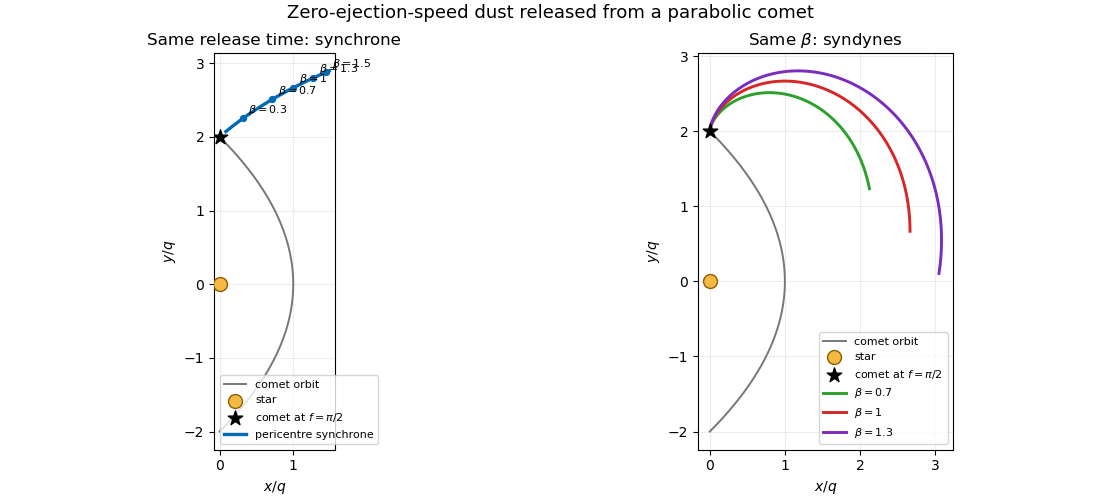
Codex 0 Created 2026-09-28 Updated 2026-10-14At periapsis the release velocity is tangential. A grain with feels no net stellar inverse-square force and therefore moves on the tangent line. A grain with retains an inward acceleration and bends toward the star; a grain with feels a net outward acceleration and bends away from it. At the common observation time, joining these positions in increasing gives the synchrone shown below. It starts near the low- orbital trajectory, passes through the force-free position, and extends outward through the repelled high- grains.

New to topics? Read the docs here!