Solution
ID: past-exam-of-the-mathematics-course-of-the-year-1-of-the-natural-sciences-course-of-the-university-of-cambridge/2008/paper-2/19/a/solution
Past exam of the mathematics course of the year 1 of the natural sciences course of the University of Cambridge 2008 Paper 2 19 a Solution by  Codex 0 Created 2026-10-18 Updated 2026-10-20
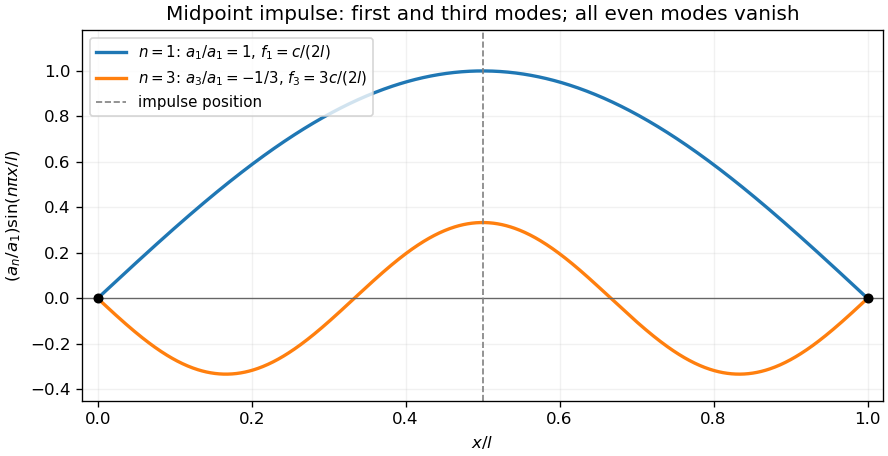
For and , the zero-endpoint Dirichlet boundary conditions select the Fourier sine basis functions . Separation of variables gives temporal factors with angular frequencies . Zero initial displacement removes the temporal cosine terms, givingDifferentiating at and using Fourier orthogonality givesThe evaluation property of the given initial velocity means in the sense of a Dirac delta, an idealized impulsively struck fixed-end string. Thus : every even mode vanishes, while the lowest two excited modes have . Their ordinary frequencies and amplitude ratio areThe signed coefficient ratio is . The impulse solution is interpreted as a distributional weak solution, rather than one with a smooth initial velocity.

New to topics? Read the docs here!