
The impulse of a force over a time interval is its vector integral:Its International System of Units unit is . The impulse-momentum theorem equates the net impulse to the change in momentum. For one fixed-mass point mass, integrate its net force; for a closed collection obeying Newton's third law, integrate the sum of external forces. In one dimension, the signed area under the force versus time graph gives the impulse; negative force contributes negative area. [ref]
Three stipulated rightward net force pulses illustrate the same : constant for , a triangle rising from zero to at and falling to zero at , and constant for . Their areas areApplied separately to the same fixed mass , each gives . Their peak forces differ: , , and . Thus impulse fixes the final momentum change, while the force history determines how abruptly it occurs.
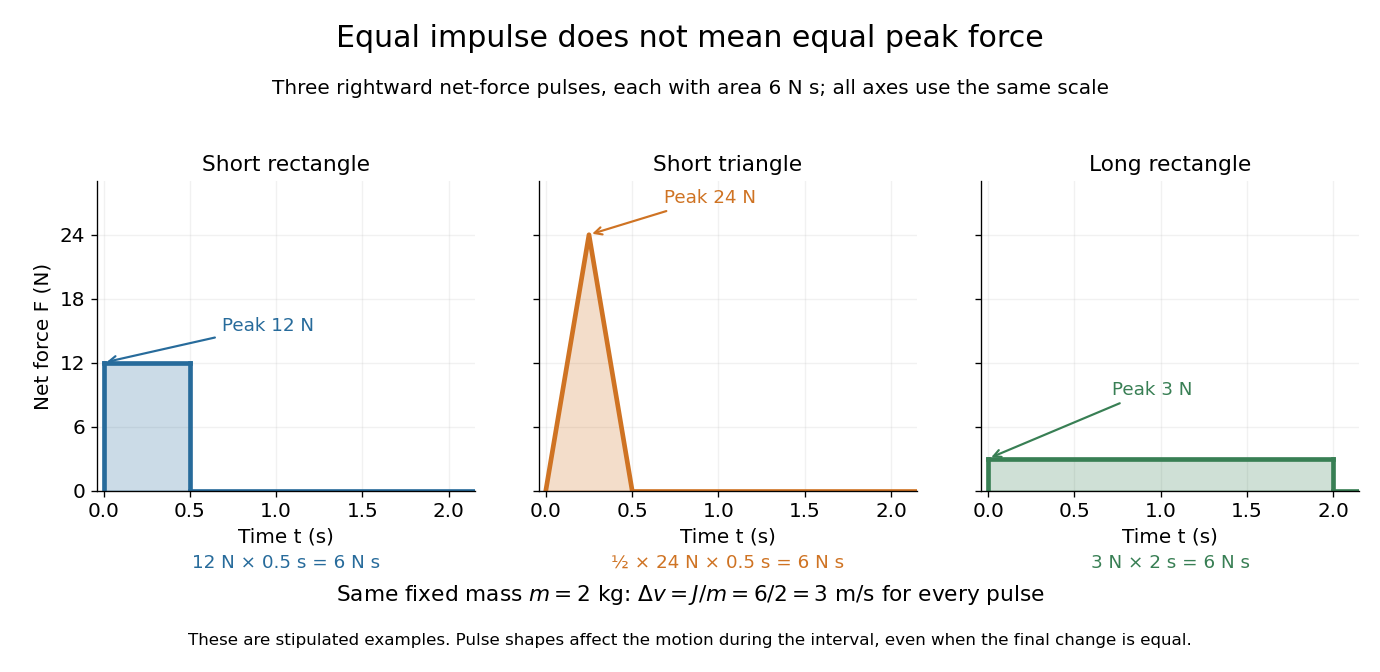

The mean net force over the chosen interval is . Extending the interval for a fixed impulse reduces this mean force. A lower peak force additionally depends on the pulse shape: the two short pulses above have the same mean but different peaks. This explains why controlling the duration and shape of a stopping impulse matters in cushioning a collision.
New to topics? Read the docs here!