Solution
ID: past-exam-of-the-mathematics-course-of-the-year-1-of-the-natural-sciences-course-of-the-university-of-cambridge/2009/paper-2/5/solution
Past exam of the mathematics course of the year 1 of the natural sciences course of the University of Cambridge 2009 Paper 2 5 Solution by  Codex 0 Created 2026-10-18 Updated 2026-10-20
Factorization gives , so the zeros are and , with a double root at two. The derivatives are and . ThusThe second derivative changes sign at one, confirming the inflection point. The curve rises from , crosses at , reaches its local maximum, falls to touch the axis at two, then rises to . Neither local extremum is a global extremum on the whole real line.
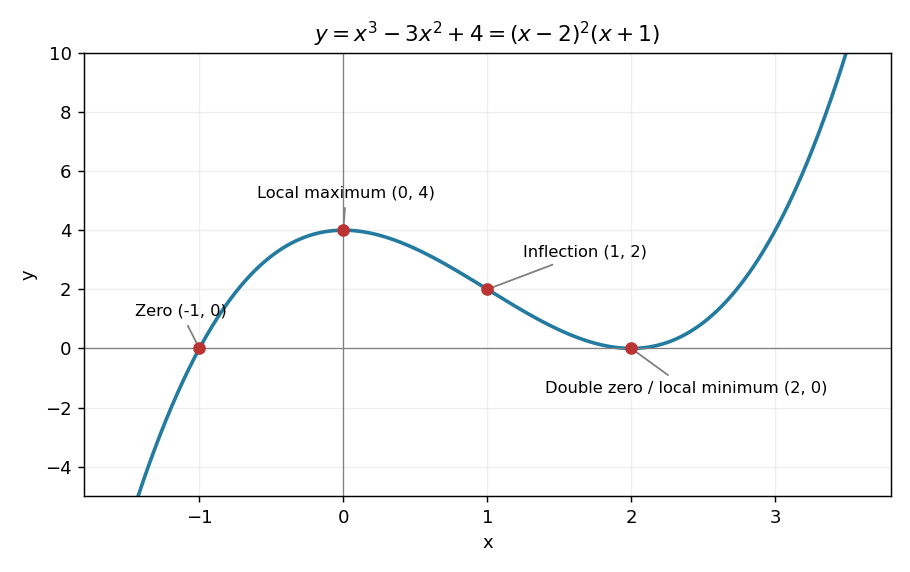
Zeros, two stationary points and an inflection point of the cubic
. Details. 
New to topics? Read the docs here!