Solution
ID: past-exam-of-the-mathematics-course-of-the-year-1-of-the-natural-sciences-course-of-the-university-of-cambridge/2019/paper-2/14/d/iii/solution
Past exam of the mathematics course of the year 1 of the natural sciences course of the University of Cambridge 2019 Paper 2 14 d iii Solution by  Codex 0 2026-10-18
Codex 0 2026-10-18The probability density is an even function. Its derivative simplifies toIt increases for and decreases for , with maximum height . Thus the most probable value, or mode, is . The original sketch shows the symmetric, slightly flattened peak and long tails.
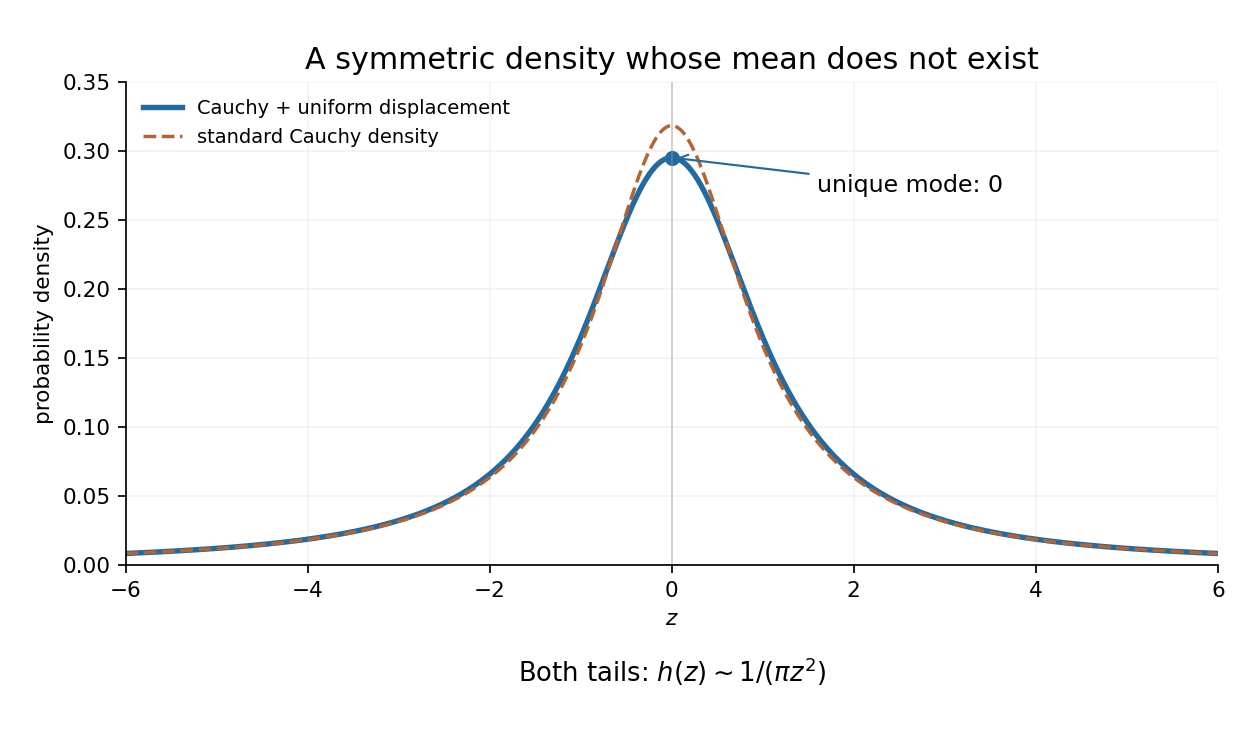

There is a genuine qualification to the request for a mean: the mean does not exist. The integral representation shows that as , soThe two divergent integrals cannot be subtracted to define an expected value. Symmetry does give the Cauchy principal value , but that is not the mean. Equivalently, adding the bounded variable cannot make the first absolute moment of a Cauchy distribution finite.
New to topics? Read the docs here!