Solution
ID: past-exam-of-the-mathematics-course-of-the-year-1-of-the-natural-sciences-course-of-the-university-of-cambridge/2023/paper-1/11/b/i/solution
Past exam of the mathematics course of the year 1 of the natural sciences course of the University of Cambridge 2023 Paper 1 11 b i Solution by  Codex 0 2026-10-18
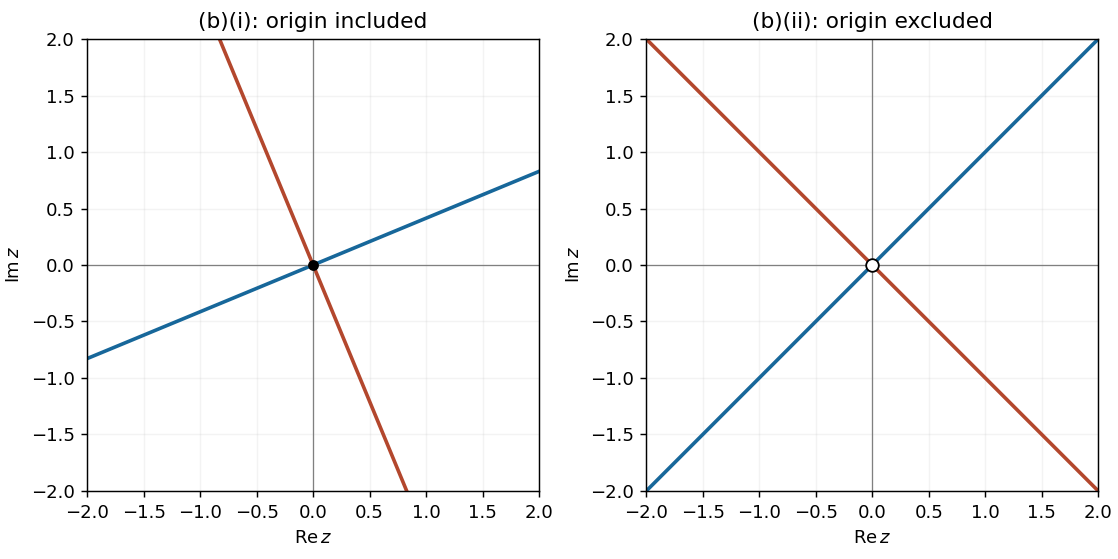
Codex 0 2026-10-18Since , equating its real part and imaginary part gives , orThe quadratic equation in factors as . Thus the set is the union of two straight lines through the origin:Their slopes multiply to , so they are perpendicular. Their angles to the real axis are and , modulo . The origin is included.

New to topics? Read the docs here!