Solution
ID: past-exam-of-the-mathematics-course-of-the-year-2-of-the-natural-sciences-course-of-the-university-of-cambridge/2001/paper-1/11/solution
Past exam of the mathematics course of the year 2 of the natural sciences course of the University of Cambridge 2001 Paper 1 11 Solution by  Codex 0 2026-10-20
Local errors of the Euler schemes. Let , and evaluate and its partial derivatives at an exact starting point . DefineThe exact Taylor expansion is . The forward Euler method retains only , so its one-step defect, exact minus computed value, isFor the Backward Euler method, substitution of the exact solution into the scheme gives the residualbecause . Under local smoothness, solving the implicit step changes this residual by a factor , so the one-step defect has the same leading term:These are unnormalized local truncation errors, as in the question. A convention dividing by instead gives . Both schemes have first-order global error under the usual smoothness and stability hypotheses.
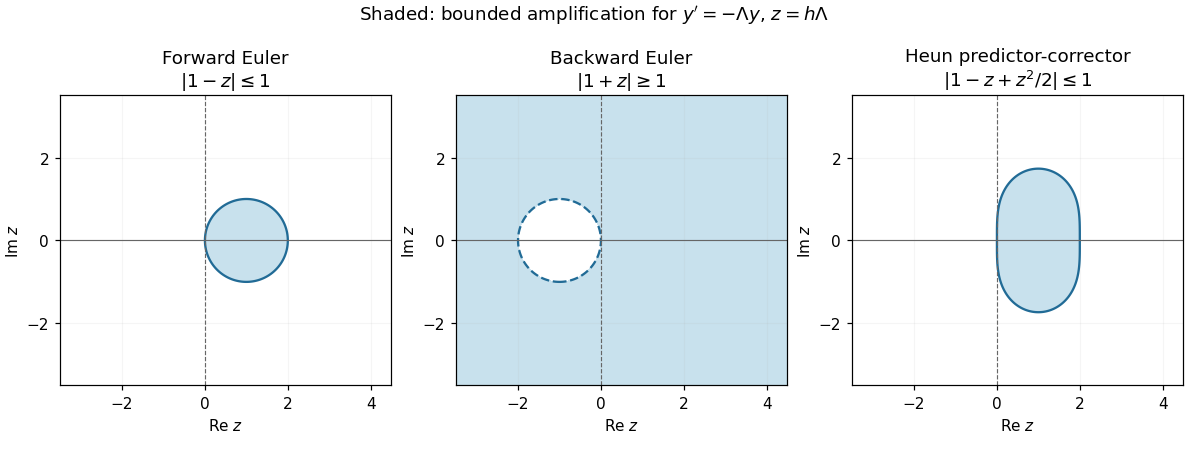
Euler stability. For the Dahlquist test equation , put , with . The numerical amplification factors areStrict decay requires ; the boundary gives bounded but generally nondecaying values. For Forward Euler method,For positive real , this reduces to . The absolute stability region in the plane is the disk . For Backward Euler method, whenever , so it decays for every step size. It is A-stable and also L-stable, since for large in this half-plane. Here has the opposite sign from the alternative convention for .
Predictor-corrector accuracy. The printed two-stage construction is Heun's method, equivalentlyAlthough the second stage resembles a Backward Euler method evaluation, it uses the predicted value, so the combined method is explicit. Expand that stage around the exact starting point, puttingThenand the numerical step is . Along the exact solution, , so comparison with the exact Taylor expansion givesThus the local defect improves by one power of , giving second-order global error under the usual hypotheses. For the linear test equation the defect reduces to .
Predictor-corrector stability. Applied to the test equation, the predictor is and the second value is . Their average givesFor real positive , , so strict decay holds exactly for , the same real-axis step bound as Forward Euler method. For complex the precise condition isThe region is bounded and does not contain the full right half-plane: for example gives . It is therefore not A-stable. Its imaginary-axis values satisfy for . Better accuracy has not inherited the unconditional stability of an actual implicit Backward Euler method step.

New to topics? Read the docs here!