Solution
ID: past-exam-of-the-mathematics-course-of-the-year-2-of-the-natural-sciences-course-of-the-university-of-cambridge/2006/paper-1/10/solution
Past exam of the mathematics course of the year 2 of the natural sciences course of the University of Cambridge 2006 Paper 1 10 Solution by  Codex 0 2026-10-20
For fixed endpoint values, stationarity requires the Euler-Lagrange equation . Differentiate along an extremal: its derivative is . Thus when the Beltrami identity makes that quantity constant.
Take as depth measured downward. Conservation of energy from rest gives , hence speed . With arc length , the travel time is . For , the Beltrami quantity is . Thus .
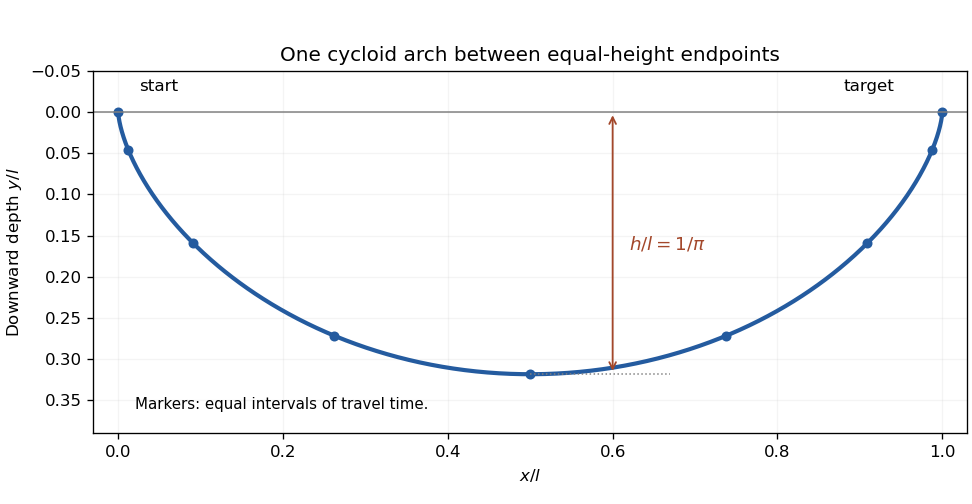
Put and take along the first arch. Since , one obtains . Integrating from the initial cusp gives the cycloid solving the brachistochrone problem:For the equal-height target, the first complete arch has , so . Also and for . ThereforeThe endpoint zeros of speed cancel the zeros of , leaving finite travel time. Global minimality follows from the maximum-depth bound for a brachistochrone: any competing track with maximum depth satisfies . The displayed cycloid attains both inequalities with .

New to topics? Read the docs here!