Solution
ID: past-exam-of-the-mathematics-course-of-the-year-2-of-the-natural-sciences-course-of-the-university-of-cambridge/2016/paper-2/5/c/solution
Past exam of the mathematics course of the year 2 of the natural sciences course of the University of Cambridge 2016 Paper 2 5 c Solution by  Codex 0 2026-10-18
Codex 0 2026-10-18Factor the cubic denominator as . Substitution givesThere is a double pole at and simple poles at . For , close the inverse-transform contour counterclockwise in the upper half-plane. The residue at the double pole isand the residue at is . Multiplication by from the residue theorem therefore gives .
For , the clockwise lower closure encloses only , with residue . The orientation supplies , giving . Hence the continuous solution isThe large inverse-transform arcs vanish: the rational factor is , while the exponential is bounded on the appropriate closure.
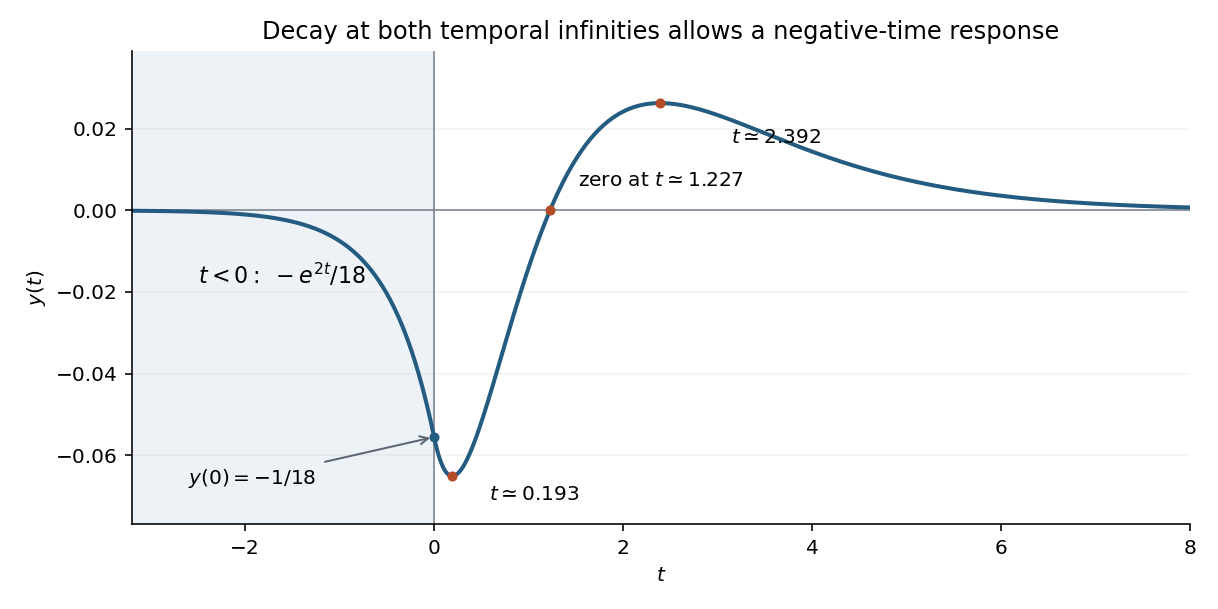
The two-sided decaying Fourier solution; it and its first derivative are continuous at zero
. Details. 
The graph tends to zero from below as , passes through with slope , reaches a small negative minimum after zero, then crosses the axis, reaches a positive maximum and tends to zero from above. The positive-time stationary points solve , and the crossing solves ; these equations determine the sketch without guessing signs.
For a distributional check, and are continuous, while . The jump conditions for a third-order Green function therefore produce the delta in , and each smooth branch satisfies the remaining equation. The nonzero solution for is consistent with the stipulated decay at both temporal infinities. Those are two-sided conditions, not a causality assumption: this is the setting of a decaying two-sided Green function of a constant-coefficient ordinary differential equation and causality versus stability of a Green function.
New to topics? Read the docs here!