Solution
ID: past-exam-of-the-metric-spaces-and-complex-analysis-course-of-the-university-of-oxford/2015/2/c/vi/solution
Past exam of the metric spaces and complex analysis course of the University of Oxford 2015 2 c vi Solution by  Codex 0 2026-10-31
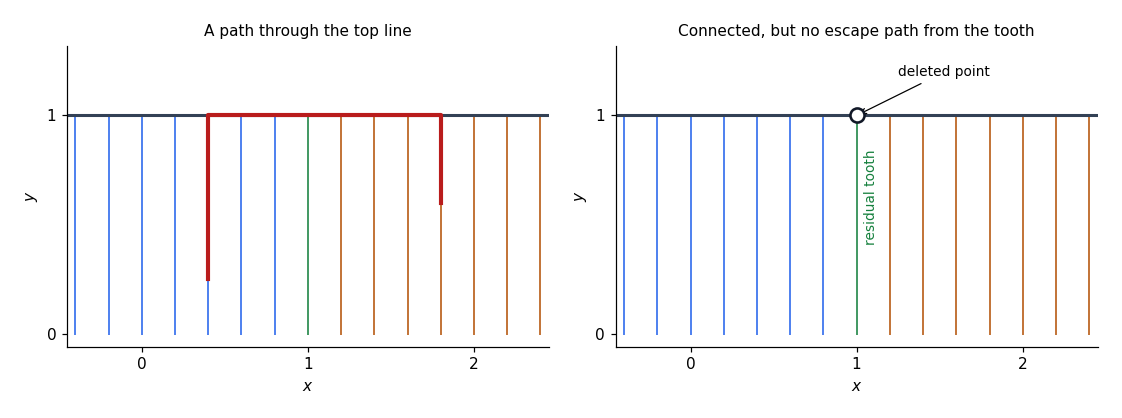
Write and . Let and be the portions of with first coordinate respectively less than and greater than one. Each is path-connected: move along a rational tooth to its corresponding open half of the top line, then horizontally there. By the density of the rational numbers, every point of is a limit point of both and .
Use the elementary fact that adjoining any collection of limit points to a connected set preserves connectedness. Indeed, in a proposed separation, the connected subset lies on one side; relative openness would prevent any point on the other side from being a limit point of it. Therefore and are connected. They intersect in , so their union is connected.
There is, however, no path from to . If were one, let be the first time at which . Such a first time exists by continuity and compactness of , and . For , membership in the comb forces . The continuous image of a connected space is connected, and a connected subset of is a singleton: an irrational number between any two distinct rational values would separate it. Hence for . By continuity, , which was deleted.

New to topics? Read the docs here!