Solution
ID: past-exam-of-the-mphil-in-micro-and-nanotechnology-enterprise-course-of-the-university-of-cambridge/2017/paper-1/section-b/8/ii/solution
Past exam of the MPhil in micro- and nanotechnology enterprise course of the University of Cambridge 2017 Paper 1 Section B 8 ii Solution by  Codex 0 2026-10-20
Choose cyclic reciprocal units, so the incident and elastically scattered wavevectors have magnitude . Place the reciprocal lattice origin at the end of the incident vector from the sphere centre . A reciprocal vector is excited when its endpoint lies on the Ewald sphere, becauseA specimen tilt rotates the reciprocal lattice relative to this construction. The very short electron de Broglie wavelength makes the sphere nearly flat across several ordinary reciprocal-lattice spacings. In a thin foil, finite thickness broadens reciprocal points into reciprocal lattice rods approximately along the foil normal, with characteristic longitudinal extent . A rod may intersect the sphere even when its ideal point is slightly off it. Consequently several reflections can appear simultaneously near a zone axis, and thinning changes the excitation tolerance. A small particle has finite-size broadening in other directions too. This geometrical excitation condition does not guarantee a particular spot intensity: crystal basis structure factors, specimen thickness and dynamical diffraction still matter.
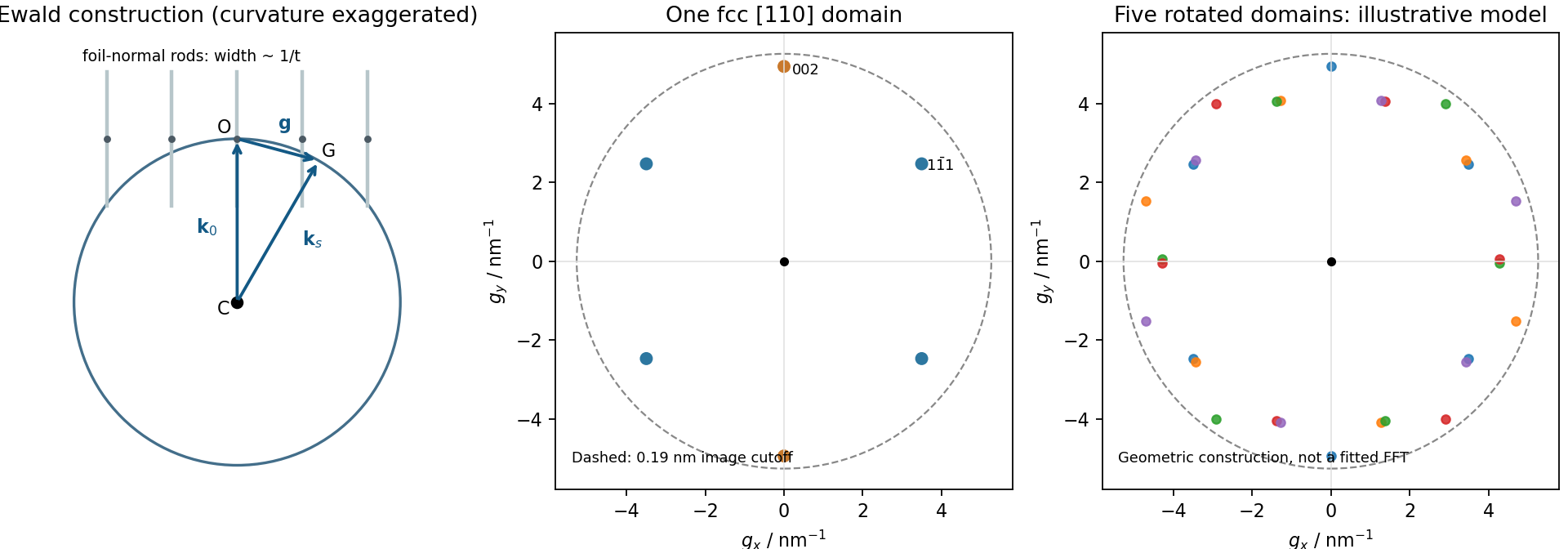
Local Ewald sphere intersections and calculated fcc gold reflections
. Details. 
New to topics? Read the docs here!