Solution
ID: past-exam-of-the-mphil-in-micro-and-nanotechnology-enterprise-course-of-the-university-of-cambridge/2017/paper-2/section-a-i/13/i/solution
Past exam of the MPhil in micro- and nanotechnology enterprise course of the University of Cambridge 2017 Paper 2 Section A(i) 13 i Solution by  Codex 0 2026-10-20
A decahedral nanoparticle is a multiply twinned nanoparticle: five fcc-like tetrahedral domains share a common fivefold axis and meet on coherent twin planes. The angle of an ideal fcc tetrahedral wedge is , so five wedges leave about of angular deficit. Elastic distortion and defects accommodate closure. The external shape can be a pentagonal bipyramid or a truncated variant; it is not one unstrained, periodically repeated fcc crystal.
An icosahedral nanoparticle comprises twenty tetrahedral domains arranged around a common centre, with twenty approximately triangular outer facets, twelve vertices and thirty edges. Five domains meet around each radial fivefold direction. Coherent twinning exposes many low-energy close-packed facets, but fivefold symmetry cannot tile ordinary three-dimensional space periodically without strain. The competition between favourable surface/twin energies and volume-dependent elastic strain explains why such morphologies are especially plausible for small particles.
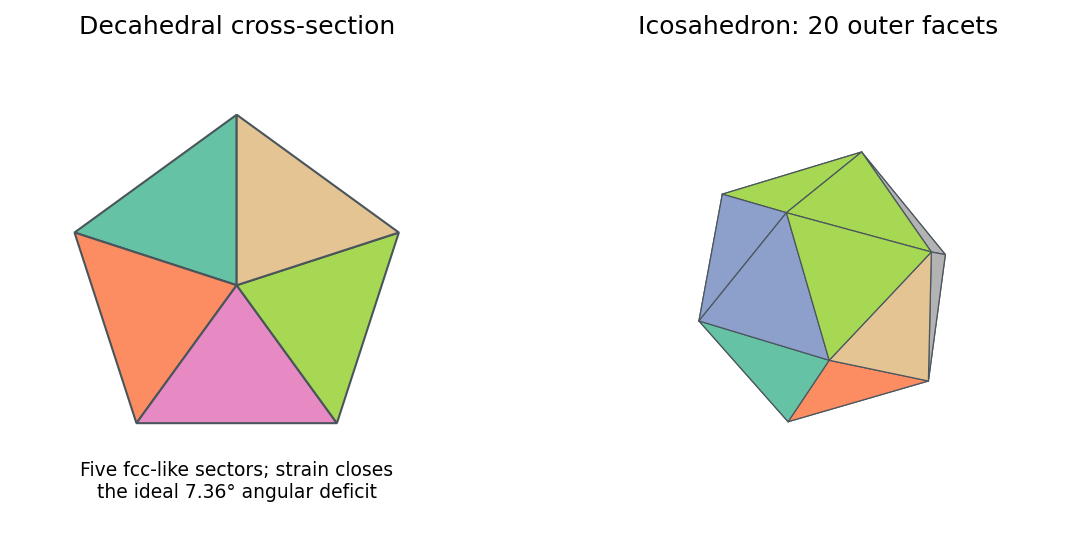
Five tetrahedral sectors in a decahedral cross-section and the twenty outer facets of an icosahedron
. Source. Details. 
These labels describe the observed domain geometry; cobalt can adopt different crystal phases, so identifying fcc-like twinning also requires diffraction rather than assuming every cobalt particle is bulk fcc.
New to topics? Read the docs here!